About Kennedia rubicunda (Schneev.) Vent.
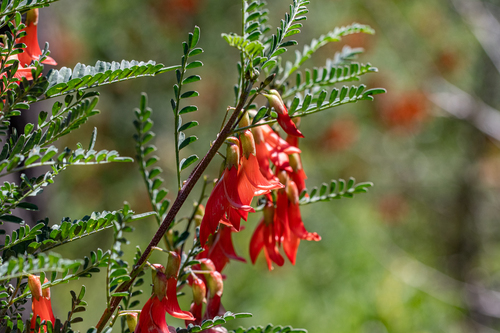
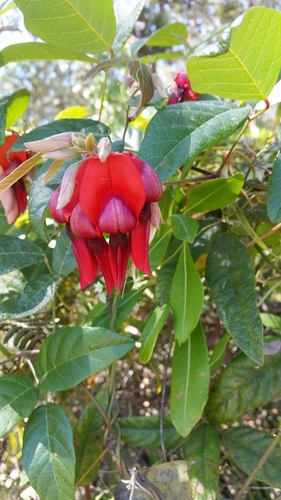
Kennedia rubicunda (Schneev.) Vent. is a twining or prostrate herb with stems up to 4 metres (13 ft) long, and its stems are covered in rusty-brown hairs. Its leaves are trifoliate, growing on a petiole 10–50 mm (0.39–1.97 in) long. Individual leaflets are egg-shaped to lance-shaped, 30–120 mm (1.2–4.7 in) long and 20–80 mm (0.79–3.15 in) wide. Lance-shaped stipules 2–4 mm (0.079–0.157 in) long grow at the base of the petiole. Dark red pea-shaped flowers are arranged in racemes that hold up to twelve flowers each. These racemes grow on a peduncle 20–70 mm (0.79–2.76 in) long, and each individual flower sits on a pedicel 10–20 mm (0.39–0.79 in) long. The sepals are 10–15 mm (0.39–0.59 in) long, densely covered in rusty-brown hairs, and the petals measure 30–40 mm (1.2–1.6 in) long. Flowering mostly occurs from September to December. After flowering, it produces a flattened, rusty-hairy pod 50–100 mm (2.0–3.9 in) long that holds ten to fifteen seeds.
Kennedia rubicunda is widespread across a range of habitats, including forests and rainforest margins, on the coast and adjacent tablelands of Queensland, New South Wales, and far eastern Victoria. It is an introduced species in India, Tasmania, and the North Island of New Zealand, where it is classified as a weed.
The flowers of K. rubicunda are pollinated by birds. Seed dispersal by ants, a process called myrmecochory, has been observed: ants are attracted to fatty acid-rich elaiosomes attached to the outside of the plant's seeds. K. rubicunda is killed by bushfire, but it regenerates from seeds that remain dormant in soil, and it is often abundant after fire. This species forms a symbiosis with soil nitrogen-fixing rhizobia bacteria, which leads to the formation of root nodules that fix atmospheric nitrogen the plant uses for growth.
In horticulture, this plant is known for its vigorous growth, and it can be used to cover embankments or structures. It adapts to a range of well-drained soils, and grows well in positions that receive full sun or partial shade. It is drought resistant and has some degree of frost tolerance. It can be propagated from scarified seed, or from cuttings taken from semi-mature growth.