About Kennedia coccinea (Curtis) Vent.
Kennedia coccinea (Curtis) Vent. is a twining, climbing or prostrate shrub. Its stems grow up to 4 mm (0.16 in) in diameter and are covered with white to ginger-coloured hairs. Its leaves are trifoliate: the end leaflet measures 11–83 mm (0.43–3.27 in) long and 7–55 mm (0.28–2.17 in) wide, and lateral leaflets are smaller. The upper surface of the leaves is darker green than the lower surface. Leaves are borne on a petiole 6–60 mm (0.24–2.36 in) long, and each individual leaflet grows on a petiolule 0.5–3 mm (0.020–0.118 in) long. The stipules at the base of the petiole are triangular and 1.7–5 mm (0.067–0.197 in) long.
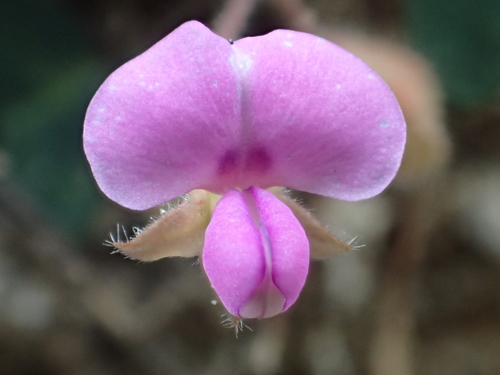
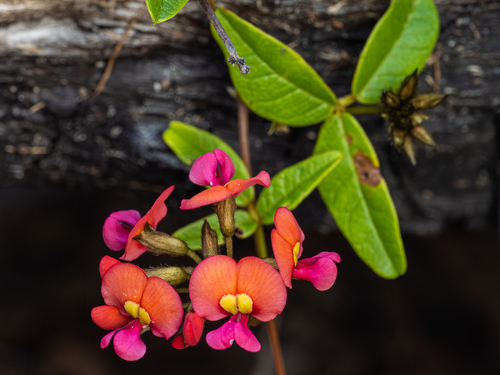
Flowers of Kennedia coccinea are 9.5–16 mm (0.37–0.63 in) long, arranged in groups of 3 to 30 on a peduncle 60–230 mm (2.4–9.1 in) long, with each flower held on a pedicel 1.5–10 mm (0.059–0.394 in) long. The five hairy sepals are 5–8 mm (0.20–0.31 in) long, with lobes 2–4 mm (0.079–0.157 in) long. The standard petal is orange-red to pink with a greenish-yellow centre, and measures 9.8–16 mm (0.39–0.63 in) long. The wings are pink and 8.9–14 mm (0.35–0.55 in) long, while the keel is red and 8–11 mm (0.31–0.43 in) long. Flowering occurs from July to December, and the fruit is a flattened, narrow oblong pod 25–72 mm (0.98–2.83 in) long.
Three subspecies of Kennedia coccinea have distinct distributions and habitats. Subspecies calcaria grows in sand over limestone in coastal heath between Jurien Bay and Albany. Subspecies coccinea grows in forest and woodland across a wide area between Northam, Augusta and Albany. Subspecies esotera grows in open forest, mallee-heath or scrub, often in disturbed areas, from near Eneabba to Albany and Israelite Bay.
In horticulture, this species is naturally adapted to sandy or lighter soils and prefers partial shade. It is resistant to drought and has some frost tolerance. Plants can be propagated from scarified seed, or from cuttings of semi-mature growth.