About Kelletia kelletii (Forbes, 1852)
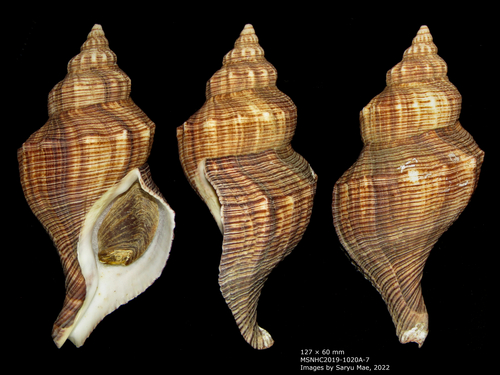
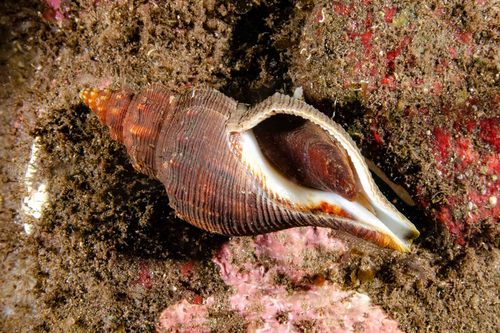
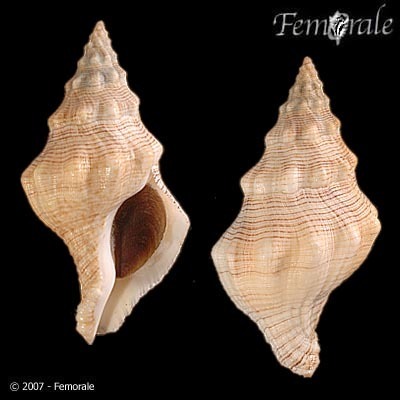
Kelletia kelletii, originally published under the name Fusus kelletii, was discovered and described by Manx naturalist Edward Forbes in 1850. Its specific epithet kelletii honors Captain Henry Kellett, who led the scientific expedition during which these snails were collected. Kellet's whelks are the largest buccinid gastropods found in southern California. Their robust, spindle-shaped, spiraled shells can reach 6.9 inches (17.5 centimeters) in length. Shells range in color from white to tan, and are often covered by encrusting organisms such as bryozoans, sponges, and algae. Kellet's whelks exhibit sexual dimorphism: the female is the larger individual in any mating pair. Females generally reach sexual maturity when their shell measures between 2.6 and 2.8 inches (6.5 and 7.0 centimeters), while males mature at slightly smaller sizes. This species is distributed from Isla Asunción, Baja California, Mexico, to Monterey, California, USA. Its type locality is the Californian coast. Studies indicate that the Kellet's whelk range expanded to Monterey Bay in the 1970s or early 1980s, possibly linked to an El Niño event, and the local population depends on new recruits from southern California. Kelletia kelletii is most commonly found in subtidal kelp forests, rocky reefs, and cobble-sand interfaces at depths between 2 and 70 meters. It is a conspicuous, abundant resident of nearshore subtidal reefs off southern California. Mature females and males aggregate seasonally to mate, and fertilization is internal. Kellet's whelks reproduce annually, with egg-laying limited to late spring and early summer, specifically March, April, and May. Spawning snails form clusters; the average spawning group holds 15 to 20 snails, though a small number of aggregations contain between 200 and 300 individuals. Females deposit oval-shaped egg capsules in clusters on hard substrates, including rocky reefs, discarded mollusk shells, and other Kellet's whelks. Researchers have hypothesized that females prefer substrates that already hold existing Kellet's whelk egg capsules. Egg deposition can happen over several days across multiple locations, or all within a single day. Each egg capsule typically holds between 400 and 1200 eggs. Both the height of the capsule and the number of eggs it contains increase directly with the size of the spawning female. Capsule height generally ranges from 0.2 to 0.4 inches (5.1 to 10.2 millimeters), and capsules may occasionally hold as many as 2200 eggs. Embryos develop inside the capsule for 30 to 34 days. After this period, they hatch into the water column as free-swimming, planktonic pelagic veliger larvae. Veliger size is inversely related to egg capsule size: smaller capsules produce larger veligers. The protoconch of Kelletia kelletii has 0.5 to 1.5 whorls and a bulbous apex. In laboratory culture studies, 33% of larvae (n=10) successfully completed metamorphosis between weeks 5.5 and 9 when held on live rock dominated by Petaloconchus montereyensis, a known prey species of Kelletia kelletii. 100% of larvae metamorphosed successfully when exposed to high concentrations of KCl during weeks 8 and 9. These preliminary results indicate that the planktonic larval stage of this species lasts at least 5.5 to 9.0 weeks. Larvae become more demersal as they approach the competency to settle and metamorphose. Kelletia kelletii is both slow-growing and slow to reach sexual maturity. Studies show a growth rate of 0.3 to 0.4 inches (7.6 to 10.2 millimeters) per year before reaching sexual maturity. In 1970, Rosenthal reported that sexual maturity begins at approximately 60 mm shell length, where shell length is defined as maximum length from the tip of the spire to the tip of the siphonal canal. Once sexually mature, growth slows drastically, and it has been estimated that individuals take at least 20 years to reach 3.5 inches (9.0 centimeters) in shell length. In a year-long tagging study in southern California, the majority of the 188 recaptured individuals showed no measurable growth by the end of the study. Shells of Kellet's whelks have been recovered from archeological and paleontological sites in southern California.