About Katsuwonus pelamis (Linnaeus, 1758)
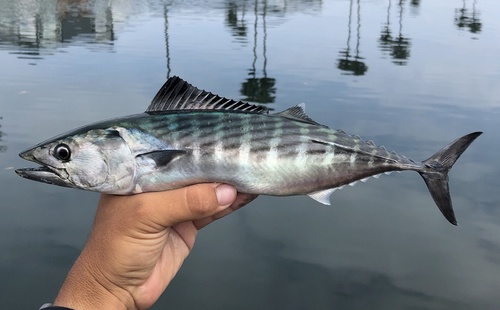
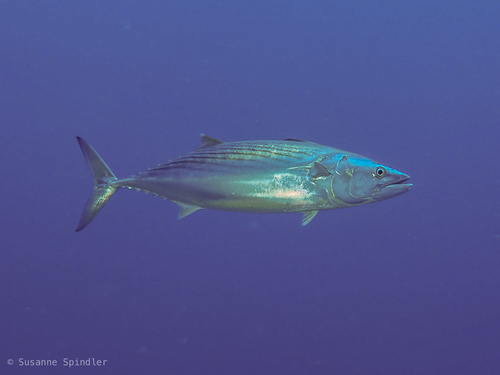
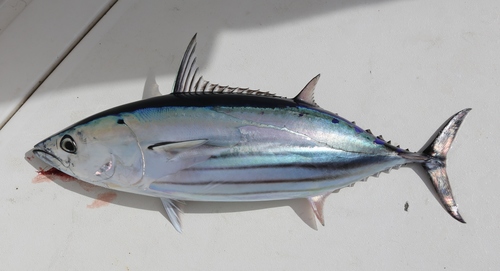
Katsuwonus pelamis, or skipjack tuna, is a streamlined, fast-swimming pelagic fish that is common across tropical waters worldwide. It inhabits surface waters in large shoals that can hold up to 50,000 fish, and these shoals are often mixed with other scombrids. Skipjack tuna feeds on fish, crustaceans, cephalopods, and mollusks. It is an important prey species for sharks and large pelagic fishes, and is often used as live bait when fishing for marlin. Most of its body has no scales; the only exceptions are the lateral line and the corselet, which is a band of large, thick scales that forms a circle around the body behind the head. Like other tuna, it lacks a swim bladder, and must keep swimming continuously to maintain buoyancy. Skipjack tuna commonly reaches a fork length of up to 80 cm (2 ft 7 in) and a body mass of 8–10 kg (18–22 lb). Its maximum recorded fork length is 108 cm (3 ft 7 in), and its maximum recorded body mass is 34.5 kg (76 lb). Determining the age of skipjack tuna is difficult, and estimated potential lifespans range from 8 to 12 years. Skipjack tuna are batch spawners. Spawning occurs year-round in equatorial waters, but becomes more seasonal in regions further from the equator. The fork length of skipjack tuna at first spawning is approximately 45 cm (18 in). This species is also known for having a potent smell. Of all recorded animals, skipjack tuna has the highest percentage of skeletal muscle devoted to locomotion, with this muscle making up 68% of the animal's total body mass. Skipjack tuna are highly sensitive to environmental conditions and changes. Climate change has significant effects on marine ecosystems, and ecological changes may alter the distribution and catchability of this fish.