About Katharina tunicata (W.Wood, 1815)
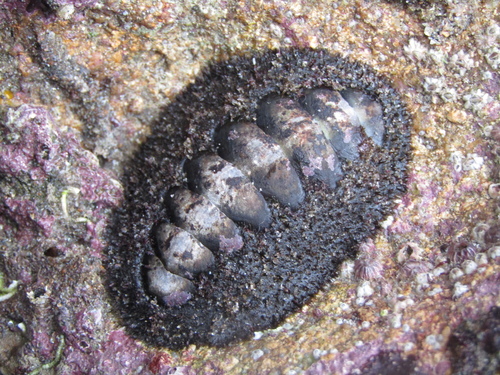
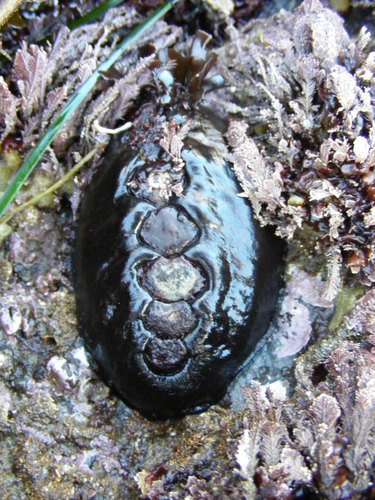
Katharina tunicata can grow up to 12 centimeters long. Individuals are generally football-shaped, with a black leathery girdle that holds eight embedded protective plates. Visible sections of these plates sometimes, but not always, have a diamond-shaped outline. The underside of this animal is dull orange or yellow. Its distribution extends from Kamchatka, Russia through the Aleutian Islands to southern California, though no modern, accurate surveys of its range currently exist. This species of chiton lives in intertidal zones down to 40 meters depth, and prefers rocky shores with heavy waves. Unlike other chitons, K. tunicata can tolerate direct sunlight. The intertidal zones it inhabits are vulnerable to contamination from industrial activities, timber harvesting, mining, seafood processing, and coastal development. Over-visitation to these habitats and over-harvesting of the species are common concerns. The current and future effects of climate change on this species are not fully understood, but climate change will likely alter the diversity and structure of the intertidal communities that K. tunicata lives in. This species is protected in the United States under the Coastal Zone Management Act. Black Katy chitons, the common name for this species, are primarily dioecious diploid organisms. They reach sexual maturity when they grow to around 35 millimeters in length. For newly settled individuals, falling temperatures in autumn trigger gonad growth. Rising temperatures in spring then trigger actual gamete production. Males release sperm into the tide, which prompts nearby females to release their eggs for fertilization. Settlement of young chitons is affected by the presence of coralline algae. Gametogenesis occurs over 5 months each year, and most individuals survive through approximately 3 reproduction cycles. Chitons go through biochemical changes as they reach sexual maturity and go through reproduction. Researchers have used K. tunicata to study the ratio of neutral and polar lipids in the organism at different life stages. Indigenous peoples of California cook this animal over coals or in earth ovens for food.