About Karomia speciosa (Hutch. & Corbishley) R.Fern.
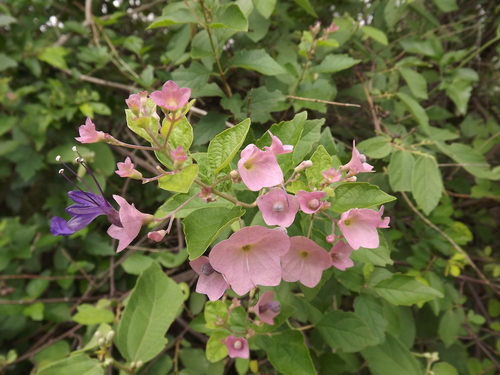
Karomia speciosa (Hutch. & Corbishley) R.Fern. is a deciduous African large shrub or bushy tree that reaches up to 7 m in height. This species was recently reclassified from the family Verbenaceae to Lamiaceae. It is one of nine species in the genus Karomia, a genus that includes species previously placed in the genus Holmskioldia. Only one species remains in Holmskioldia: Holmskioldia sanguinea, which grows in the Himalayan foothills. Karomia speciosa is closely related to the genus Clerodendrum. This species is distributed across northern South Africa, Eswatini, extends north into tropical Africa, and also occurs in Madagascar. It grows in bush or wooded habitats on hot, dry, rocky slopes, and in riverine thickets. Karomia speciosa produces abundant showy mauve and purple flowers. It may be single-stemmed or multi-stemmed, and has pale, smooth grayish-brown bark. Its leaves are softly pubescent, have coarsely toothed margins, are dark green on the upper surface, and paler green on the lower surface. The papery calyx is dusty-pink or mauve, while the bilabiate corolla is deep blue or violet. Its woody branchlets are terete, covered in short soft pubescence, and marked with pale lenticels; internodes are around 2 cm long. Leaves are broadly ovate, with a triangular apex and a broadly wedge-shaped base, measuring 2.5–4 cm long and 2–3 cm broad. They have coarsely crenate margins with around three rounded teeth, the upper surface bears very short setulae, and the paler lower surface is conspicuously glandular and covered in short pubescence. There are around three lateral nerves on each side of the midrib; the petiole is 7 mm long and densely pubescent. A small number of flowers are arranged in axillary cymes around 4 cm long; peduncles are slender and softly pubescent. Lower bracts are more or less leafy, spathulate-obovate, and grow up to 7 mm long; pedicels reach up to 1.2 cm long, and bear two small opposite linear bracteoles above their midpoint. The pink calyx gradually enlarges, is broadly top-shaped, and has glandular pubescence on its outer surface. The calyx tube is 1 cm long with broadly rounded lobes; the lobes become rigidly membranous in the fruiting stage and expand to 2.5 cm across. The purple corolla is 2–2.5 cm long, with glands and soft pubescence on its outer surface; the corolla tube reaches up to 1.5 cm long. Stamens are long and exserted, with glabrous filaments. The ovary is hairy on its upper portion; the style is slightly longer than the stamens, and is slender and glabrous. The fruit is truncate and 4-horned, and is enclosed by the accrescent calyx.