About Kaloula pulchra Gray, 1831
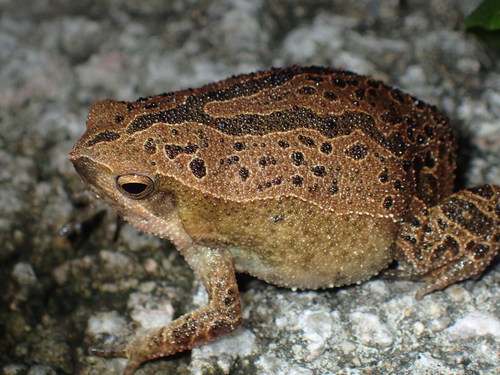
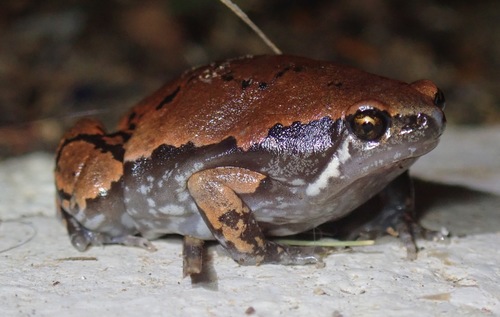
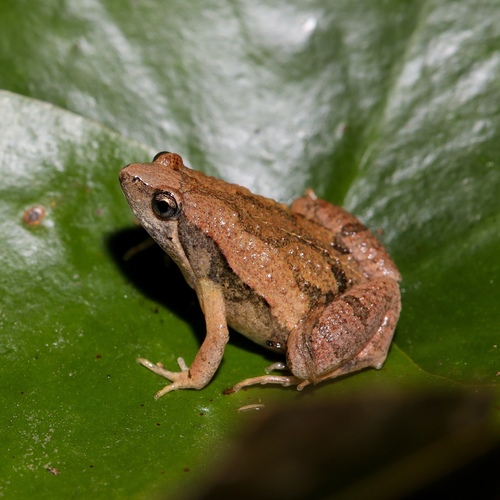
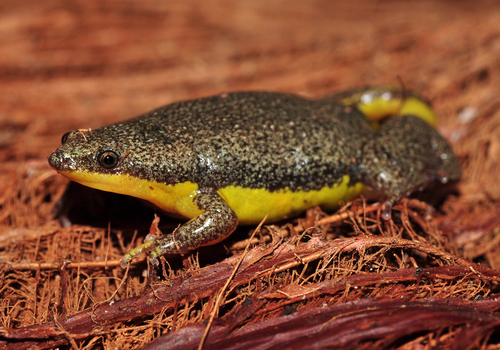
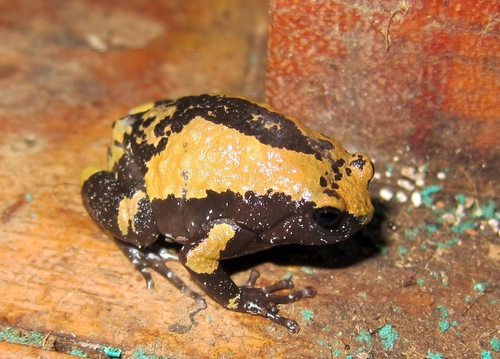
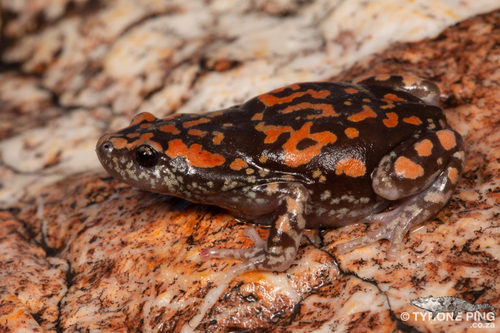
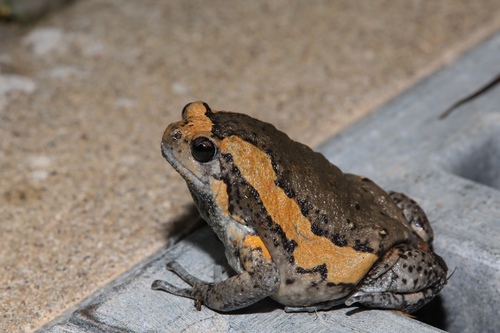
The banded bullfrog (Kaloula pulchra Gray, 1831) is a medium-sized frog with a stocky, triangular body and a short snout. Males reach a snout–vent length (SVL) of 5.4 to 7.0 cm (2.1 to 2.8 in), while females are slightly larger, with an SVL ranging from 5.7 to 7.5 cm (2.2 to 3.0 in). Apart from this small size difference, sexual dimorphism is very limited in this species. Adult banded bullfrogs have a body weight between 80 and 120 g (2.8–4.2 oz). Their back is dark brown with stripes that range in color from copper-brown to salmon pink, and their abdomen is cream-colored. Newly hatched tadpoles are around 0.5 cm (0.20 in) long, and reach an SVL of about 1.1 cm (0.43 in) when they complete metamorphosis. Tadpoles have an oval brown or black body with a pale belly, a round snout, and a moderately long, tapered tail marked with yellow speckles that has tall fins. Their relatively small eyes are positioned on the side of the head, with black or dark gray irises and a golden ring around the pupil, and tadpoles of this species do not have a tail filament. During metamorphosis, the eyes increase in size and begin to bulge, and the tadpoles develop slender limbs and digits with rounded tips. Metamorphosis begins when tadpoles are two weeks old. This species is native to Southeast Asia. Its natural range extends from northeastern India and Nepal, through southern India and Sri Lanka, to southern China (especially Hainan) and Myanmar, and south to the islands of maritime Southeast Asia. Its wider distribution compared to the closely related species Kaloula assamensis has been linked to its burrowing ability. Banded bullfrogs are found at elevations between sea level and 750 m (2,460 ft) above sea level, and can live in both urban and rural areas, as well as in forest habitats. Breeding is triggered by heavy monsoon rains, after which the frogs move from underground to rain pools or ponds to breed. They are most often seen on wetter nights. While they are not reproductively active during dry periods, their gonads remain ripe so they can mate soon after rainfall arrives. In India, male frogs begin calling after the monsoon season starts in April or May. Recorded calls from India have 28–56 pulses per second and a frequency range of 50–1760 Hz. In Thailand, calls have a dominant frequency of 250 Hz (with a call duration of 560–600 ms) and 18–21 pulses per call. The body shape of the banded bullfrog is adapted for walking and burrowing, rather than jumping. It can survive dry conditions by burying itself in the ground and waiting for rain, and burrowing also helps it avoid predators. When burrowing, it digs downward hindlimb first, then uses its forelimbs to push itself several inches under the soil, where it stays for the entire dry season. Banded bullfrogs hide under leaf litter during daylight hours, and feed in the evening. They have been found in trees, and have been observed hunting termites there.