About Kalotermes flavicollis (Fabricius, 1793)
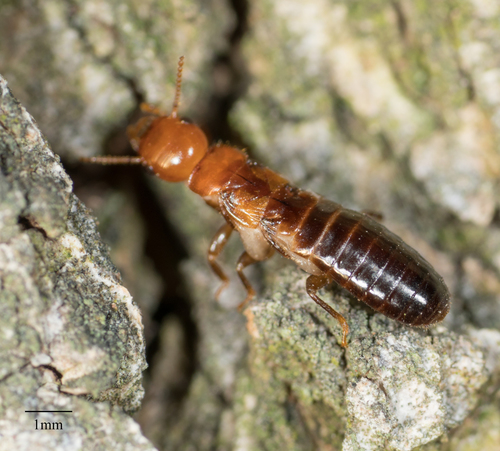
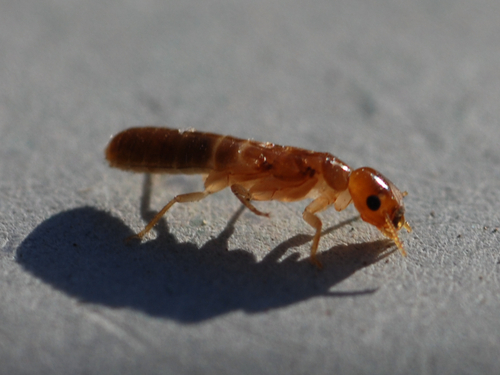
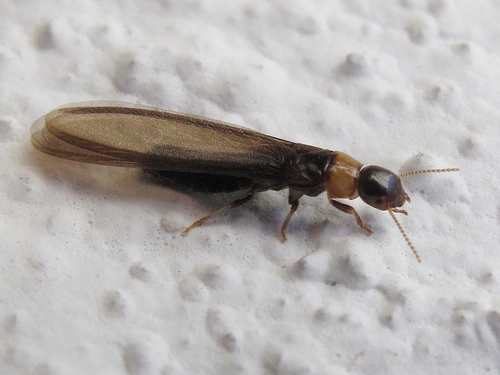
This termite species has four castes: nymphs, larvae, soldiers, and breeding adults. Nymphs measure 4 to 6 mm long and are white or creamy in color. Larvae are translucent and smaller than nymphs. Soldiers are whitish, about 8 mm long, with prominent brown heads and strong mandibles. This species does not have a specialized adult worker caste; all colony tasks are carried out by nymphs. Breeding adults reach 8–10 mm in length, with a wingspan of about 20 mm. Their basic body coloration ranges from pale yellow to dark brown. The pronotum is yellow-orange, which gives the species its specific epithet flavicollis, meaning 'yellow-necked' in Latin. Antennae and the distal leg segments are pale yellow. Males (kings) and females (queens) have more chitinous bodies, plus two pairs of long, narrow, slightly smoky membranous wings that are required for nuptial flight. When the insect is at rest, the wings are held horizontally overlapping the abdomen, so only one wing is visible. Females are on average slightly larger than males. This species is primarily distributed across the Mediterranean Basin, including Southern Europe, North Africa, and the Middle East. It has also been introduced to the Azores. As a Mediterranean species, it is most commonly found near sea coasts where temperatures are higher. These termites are xylophagous (wood-eating), so their colonies usually develop in the roots or trunks of old trees. They dig tunnels and feed on wood, which can kill infested trees. They also infest the beams and roofs of houses, as well as books in libraries and archives, causing serious damage. The nuptial flight of fertile winged males and females occurs preferentially at night, from mid-July through October. During this period, the termites swarm to found new colonies. After mating, they shed their wings and build a new colony that consists of the royal king and queen, and approximately 1,000 to 2,000 additional individuals.