About Kalanchoe marmorata Baker
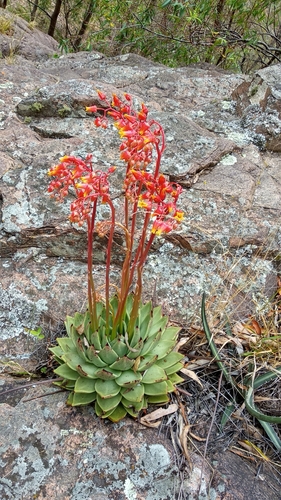
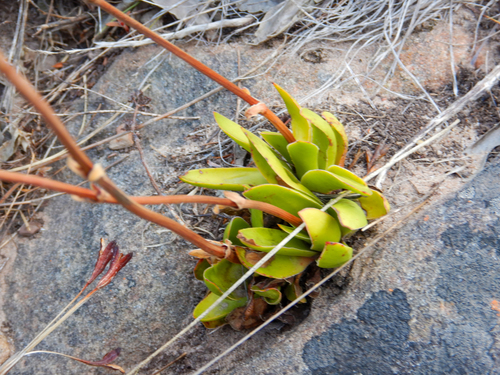
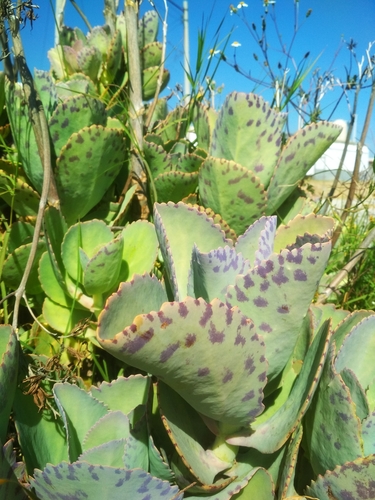
Kalanchoe marmorata Baker, commonly known as the penwiper or spotted kalanchoe, is a species of flowering succulent perennial plant in the family Crassulaceae. It is native to parts of central and East Africa, including the Democratic Republic of the Congo (formerly Zaire), Ethiopia, Sudan, Somalia, Kenya, Rwanda, and Tanzania. In cultivation, this plant typically grows as an erect or decumbent shrub-like succulent reaching around 40 cm (16 in), but can grow up to 1.2 m (3.9 ft) tall in its natural wild habitat. It has fleshy, obovate to elliptic, glaucous leaves marked with irregular purple or brown blotches, which create a distinctive marbled appearance. Older plants often shed their lower leaves, leaving bare stems behind. Its star-shaped, four-petalled flowers, which are white and sometimes tinged with pale pink, grow in upright inflorescences and bloom from late winter to spring. In its native range, Kalanchoe marmorata grows naturally in rocky grasslands, open scrub, and stony slopes, most often on hill ridges at elevations between roughly 1,250 and 2,400 m (4,100 and 7,870 ft). It is adapted to survive in seasonally dry environments, and is commonly found in areas that experience regular grazing pressure. Like many other members of the Crassulaceae family, K. marmorata has xerophytic adaptations, including thickened leaves that store water. Based on anatomical and physiological studies of the Kalanchoe genus, this species is likely able to perform Crassulacean acid metabolism (CAM) photosynthesis, a water-efficient photosynthetic pathway common to most succulents. As with many species in the Kalanchoe genus, K. marmorata contains secondary metabolites that may be toxic if ingested. While species-specific toxicity data for this plant is limited, ingestion of other kalanchoe species has been linked to adverse health effects in both livestock and pets, so caution is recommended when handling the plant around animals or people. Phytochemical studies of Kalanchoe marmorata have found a range of phenolic compounds and flavonoids, including quercetin derivatives, in its leaves. These compounds have known antioxidant activity, and have been studied in connection with the traditional medicinal use of the Kalanchoe genus across Africa. Although multiple Kalanchoe species are commonly used in traditional African medicine, there is far less documented ethnobotanical use of K. marmorata itself, compared to more extensively researched species such as Kalanchoe pinnata. Kalanchoe marmorata is widely cultivated as an ornamental plant, valued for its decorative foliage and attractive flowers. It grows best in bright light or full sun, planted in well-drained soil with infrequent watering. The minimum temperature suitable for its cultivation is approximately 12 °C (54 °F), so in temperate regions it is most often grown under glass or kept as a houseplant.