About Kajikia audax (Philippi, 1887)
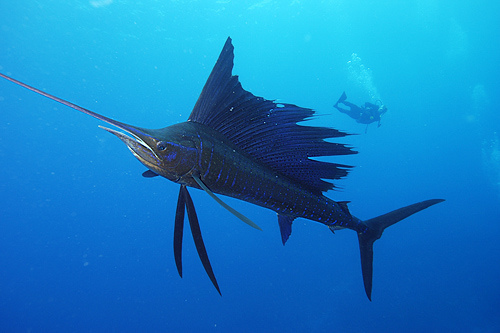
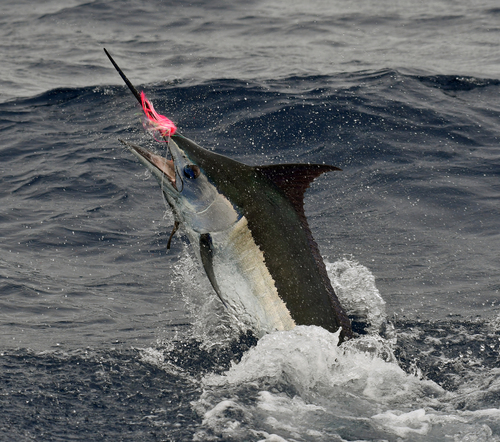
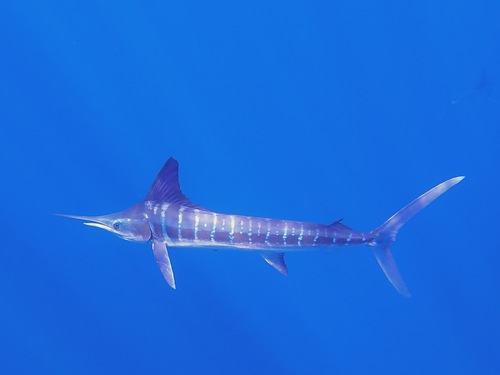
Kajikia audax (Philippi, 1887), commonly known as the striped marlin, has a torpedo-shaped body with countershading: it is dark blue or black on the upper side and silvery-white on the underside. It reaches an average length of 2.9 m (9.5 ft), a maximum length of 4.2 m (13.8 ft), and a maximum weight of 220 kg (490 lb). Its first dorsal fin is tall, equal to or larger than its body depth, and is supported by 42–48 fin rays; its second dorsal fin is much smaller. The fish has around 12–20 distinct bluish stripes along its sides, which remain visible even after death. Specialized pigment cells called chromatophores contract or expand to change the stripes from blue-tinged to lavender when the fish is excited.
Striped marlin are epipelagic, living offshore close to the water's surface. They have a wide global distribution, and are typically found in tropical and/or temperate waters. One study using opportunistic occurrence data to examine the species' habitat preferences found that the eastern Pacific Ocean is one of the most suitable habitats for this species. The study also found that the species' largest populations live in waters with dissolved oxygen levels between 4.5 and 5.5 mL/L, and sea surface temperatures between 20 and 28 °C (68 and 82 °F). Chlorophyll a levels were identified as the most influential factor shaping striped marlin distribution. High chlorophyll a levels indicate high productivity, or nutrient content, in an aquatic ecosystem. Abundant nutrients support the growth of aquatic plants and algae, which draw in congregations of the small species that striped marlin primarily prey on.
Striped marlin show clear diel vertical migration patterns. Studies across multiple tested regions, including waters off Australia, New Zealand, Mexico, California, and Ecuador, confirm that the fish generally occupy deeper water during the day, and gather near the surface at night.
The maximum lifespan of striped marlin is 10 years. Males reach sexual maturity at 1–2 years of age or at a length of 1.4 m (4.6 ft), while females reach sexual maturity at 1.5–2.5 years of age or at a length of 1.8 m (5.9 ft). The species spawns repeatedly during its summer spawning season, which can include 4 to 41 separate spawning events. Females release batches of eggs every few days, with a total of up to 120 million eggs per spawning season.