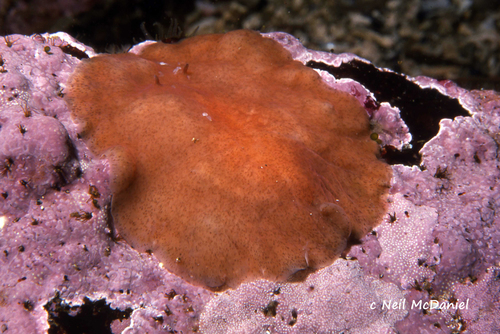
About Kaburakia excelsa Bock, 1925
Kaburakia excelsa can grow to a length of at least 9 cm (3.5 in). Its body is flat, and is nearly as broad as it is long. It has a pair of fleshy nuchal tentacles on the anterior end of its body, close to where its brain is located, and these tentacles are retractable. A number of simple eyespots are present on the tentacles and near their base; more eyespots are located above the brain, and a row of eyespots runs around the body margin. The marginal eyespots are hard to see in living specimens, but the gut can be seen through the worm’s skin, and has the branching structure typical of this order of flatworms. The upper surface of the body is tan, with a small number of darker brown streaks and spots, while the underside is paler and mostly lacks spots. This species does not have any suckers on its underside. It can be told apart from other flatworms in its native area by its much larger size, and it is actually one of the largest flatworms in the world, reaching lengths of over 9 cm. This flatworm is native to the western seaboard of North America, with a range that extends from Sitka, Alaska to the Baja California peninsula in Mexico. It occurs on the lower shore and in the shallow sub-littoral zone, where it can be found under rocks, on pilings, on the fouled hulls of boats, and among mussels and rock-boring bivalves. The natural diet of this flatworm is unknown, but it will eat mussels when kept in a laboratory. It moves away from light, and wrinkles form along its body margins as it moves. In Washington State, breeding occurs in March. When kept in the laboratory, this flatworm has been recorded breeding between June and August, and also in December. Its eggs are golden yellow and enclosed in capsules. Around 150 eggs are laid at a time, packed closely together in one or two layers to form an egg plate that adheres to a rock surface. At a temperature of 12 °C (54 °F), the eggs hatch in five or more weeks, and the offspring develop directly. Newly hatched young are pale brown, and have five to seven eyespots. By one week after hatching, their colour has darkened, with the front end becoming browner and the hind end becoming reddish.

