About Jynx ruficollis Wagler, 1830
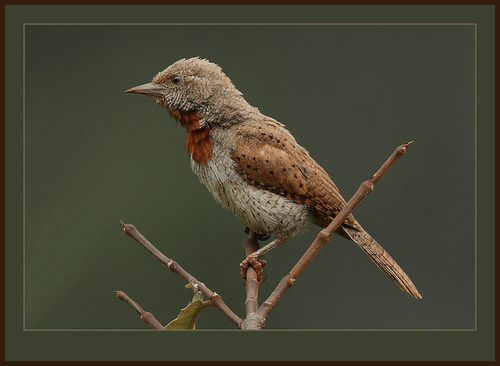
Jynx ruficollis, commonly called the red-throated wryneck, reaches an adult length of about 19 cm (7.5 in). Males and females have very similar external appearance and cannot be told apart in the field. On average, males are 2–3% larger than females, have shorter tails, and weigh more: males weigh 52–59 g (1.8–2.1 oz), while females weigh 46–52 g (1.6–1.8 oz). It is a slim, elongated bird with a small head, fine bill, and long fan-shaped tail, and has a body shape unlike a typical woodpecker. Its plumage is overall cryptic, patterned with greys, browns, and black. Its upperparts and head are brown, with dark barring and mottling; its rump and upper tail coverts are grey, with brown and black speckles. For the nominate subspecies Jynx ruficollis ruficollis, the chin, throat, and breast are red; the lower breast and belly are white with some dark streaks; the flanks and underside of the tail have a cinnamon tint. The wings are brown on the upper surface and a lighter buff tone on the lower surface. It has a long, thin grey bill, chestnut irises, and grey legs. Like all woodpeckers, its first and fourth toes point backward, and its second and third toes point forward, an arrangement that works well for clinging to vertical surfaces. Young birds resemble adults by 20 days old, but are darker and more heavily barred on the upperparts, lightly barred on the underparts, and have a smaller, darker red throat patch. The three recognized subspecies differ in appearance primarily based on how far the red breast coloration extends. In Jynx ruficollis ruficollis, red extends from the chin to the chest. In J. r. aequatorialis, red extends further down the breast, and the flanks have a stronger cinnamon tint. J. r. pulchricollis has a white chin and upper throat barred with brown; its red patch is darker and restricted to the lower throat and upper breast. This subspecies also has more rufous-colored upperparts. The two wryneck species cannot be mistaken for any other bird species, though Eurasian wrynecks may winter within the red-throated wryneck’s range. Compared to the migratory Eurasian wryneck, the African red-throated wryneck can be distinguished by its usually obvious red throat, larger overall size, browner overall appearance, and lack of a dark streak running through the eye. This species is also sometimes called the rufous-necked wryneck, and its entire distribution is limited to sub-Saharan Africa. It occurs across approximately 20 countries in separated, disjunct ranges, stretching from Nigeria, Cameroon, the Central African Republic, and Ethiopia in the north, down to South Africa and Eswatini in the south. It is not truly migratory, though it may make small local movements and disperse after breeding. It is a vagrant in Sudan, South Sudan, and Zimbabwe, and an occasional non-breeding visitor to Lesotho. Its preferred habitat is open grassland that contains scattered trees, most often acacia, and it also occurs in miombo woodlands. It can also be found in other semi-open woodland types, including forest edges and woodland clearings. It will use human-altered habitats including farmland, parks, and gardens, as long as trees are present, which can include introduced species like eucalyptus and conifers. It occurs at altitudes ranging from 600 metres (2,000 ft) to 3,300 metres (10,800 ft). In South Africa it can be found up to 1,550 metres (5,090 ft), and in Kenya it mostly occurs between 1,400–2,500 metres (4,600–8,200 ft).