About Junonia orithya Linnaeus, 1758
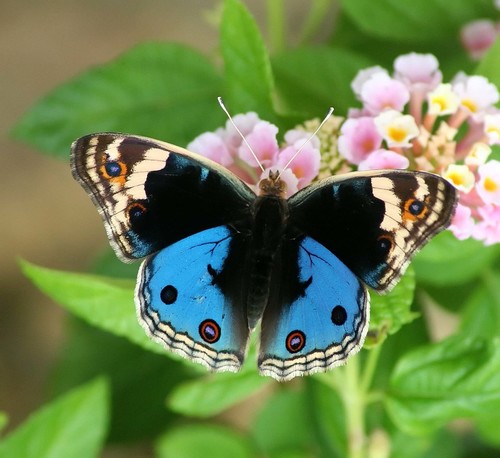
This is a description of Junonia orithya Linnaeus, 1758. For males: On the upperside, a little more than half of the forewing from the base is velvety black, and the apical half is dull fuliginous. The cell area may or may not have two short transverse orange bars. There is a blue patch above the tornus. The outer margin of the basal black area forms an obliquely zigzag line running from the middle of the costa to the apex of vein 2; this line encloses a large discal, generally obscure ocellus, which in some specimens is prominently ringed with orange yellow. Beyond this ocellus is a broad, irregularly oblique white discal band, followed by a short oblique preapical bar extending from the costa. There is a small black ocellus ringed with orange beneath this bar, a continuous subterminal line of white spots in the interspaces, and a slender terminal jet-black line. The cilia are alternately dusky black and white. The hindwing is blue, shaded with velvety black toward the base. In interspace 2, there is a postdiscal black ocellus with a white center that is ringed with orange and black. In interspace 5, there is a round velvety-black spot with a minute white center, which is sometimes entirely absent. The termen is narrowly white, crossed by an inner subterminal black line, an outer subterminal black line, and a terminal black line. The cilia are white. On the underside of the forewing, the basal half has three broad, sinuous, ochraceous-orange transverse bands that are edged in black, followed by the pale discal band. Ocelli, the preapical short bar, and subterminal and terminal markings are largely the same as those on the upperside. The discal band is margined on the inner side by a broad angulated black line that follows the outline of the black area on the upperside. The hindwing is irrorated, or sprinkled, with dusky scales. It is crossed transversely by slender zigzag brown subbasal and discal lines, and a dark postdiscal shade; the two ocelli are positioned on this dark postdiscal shade, matching their placement on the upperside. There are faint brown subterminal and terminal lines, and a short brownish streak tipped with black at the tornal angle below the lower ocellus. For females: Females are similar to males, but their ocelli and markings are larger and more clearly defined. On the upperside, the basal half of the forewings and hindwings is fuliginous, or sooty, brown, and there is scarcely any trace of blue on the hindwing. The antennae are brown, the head is reddish brown, and the thorax and abdomen above are brownish black. The palpi, thorax, and abdomen beneath are dull white. Larval host plants of this species are recorded from the plant families Acanthaceae, Annonaceae, Convolvulaceae, Labiatae, Plantaginaceae, Scrophulariaceae, Verbenaceae, and Violaceae. Specific recorded host plants are Angelonia salicariifolia, Annona senegalensis, Antirrhinum majus, Asystasia gangetica, Asystasia scandens, Buchnera linearis, Englerastrum scandens, Hygrophila salicifolia, Hygrophila senegalensis, Ipomoea batatas, Justicia micrantha, Justicia procumbens, Lepidagathis formosensis, Lepidagathis prostrata, Misopates orontium, Phyla nodiflora, Plantago amplexicaulis, Plectranthus scandens, Pseuderanthemum variabile, Striga asiatica, Striga hermonthica, Thunbergia alata, and Viola odorata. In southern Africa, recorded food plants are Graderia subintegra, Cycnium adonense, Hygrophila species, and Plectranthus species.