About Junonia hierta Fabricius, 1798
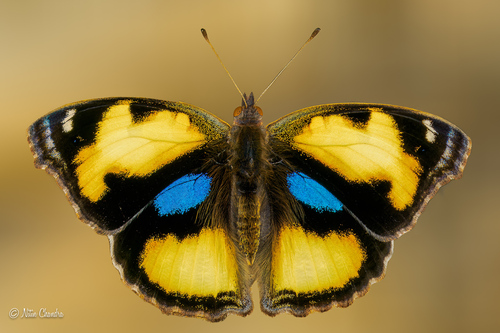
Junonia hierna is a species first described by Fabricius in 1798. Males have bright yellow coloration on the upperside of their wings. On the forewing, the costa has a broad, triangular, jet-black downward projection at the discocellulars, and the dorsum has a triangular upward projection near the tornus. This black margin narrows near the middle of the termen, and bears two short transverse preapical white streaks at the apex, crossed by black veins. Below these streaks sits an obscure ocellus that is sometimes absent. On the hindwing, the anterior half and terminal margin are black, the dorsum is broadly shaded with brown, and the anterior black area holds a large, brilliant blue spot. The cilia of both forewings and hindwings are white, alternating with brown. The underside of the forewing is pale yellow. The cell is crossed by three orange-yellow bars with black margins along their sides. Beyond this, there is a short, broad, irregular jet-black oblique band running from the costa to the base of vein 4. The hindwing is greyish yellow. Dry-season forms are heavily sprinkled with dusky scales. The hindwing has a prominent transverse brown discal fascia with highly sinuous margins. There is a broad brownish shade across the middle of the termen, and some obscure lunular marks in the basal area. The antennae are pale. The head, thorax, and abdomen are dark brownish black, with a dull ochraceous white color on the underside of the body. Females are similar to males, but have duller overall coloration. On the upperside of the forewing, the cell has a more or less complete transverse black fascia, with an additional black fascia at the discocellulars. Well-marked ocelli with blue centers are located in interspaces 2 and 5 on the disc of the forewing, and smaller ocelli are present in interspaces 2 and 5 on the disc of the hindwing. Both forewings and hindwings have a fairly well-defined pale subterminal line. The blue spot on the anterior black area of the hindwing is small and ill-defined, and all other features match those of the male. The underside matches that of the male, but generally has heavier, more clearly defined markings. This species is distributed in Africa and Southeast Asia.