About Junonia coenia Hübner
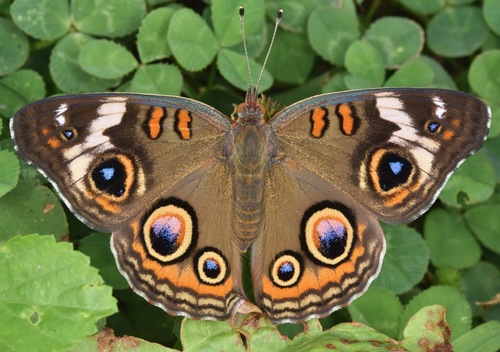
Junonia coenia, commonly called the common buckeye or buckeye, is a butterfly species in the family Nymphalidae. Its native range spans most of North America and parts of Central America, covering most of the eastern half of the United States, the lower to middle Midwest, the Southwest (including most of California), southern Canada, and Mexico. It inhabits open areas with low-growing vegetation and patches of bare ground. Genetic evidence traces the species' ancestral origin to Africa, followed by divergence in Asia. The gray buckeye, Junonia grisea, which occurs west of the Rocky Mountains, was previously classified as a subspecies of Junonia coenia. Common buckeye caterpillars prefer plants that produce iridoid glycosides, bitter compounds that trigger release of the hormone gastrin, which activates the digestive system and stimulates hunger. For this reason, iridoid glycoside-producing plants stimulate and attract the caterpillars' appetites, a relationship well-documented in species like Plantago lanceolata. The presence of these metabolites can also trigger oviposition behavior in female common buckeyes, allowing their larval offspring to accumulate iridoid glycosides in their bodies. Iridoid glycoside metabolites have a growth-stimulating effect on common buckeye caterpillars, while having a growth-reducing effect on their predators. Predators including ants, wasps, birds, and small mammals prefer to feed on caterpillars with low iridoid glycoside content over caterpillars with high concentrations, likely due to this growth-reducing effect. As a result, the ability of J. coenia larvae to resist predation by ants is strongly linked to the concentration of iridoid glycosides they sequester in their tissues. However, excessively high levels of iridoid glycosides in the diet can negatively impact the larvae's own immune response, increasing their susceptibility to parasitism. Adult common buckeyes feed on flowers that meet specific pollinator cues: they target yellow flowers that are "pre-change", meaning their color has not yet altered after insect visitation or other factors. Common buckeye caterpillars feed alone, rather than engaging in group feeding behaviors. A threat to larval survival is vulnerability to Junonia coenia densovirus.