About Juniperus scopulorum Sarg.
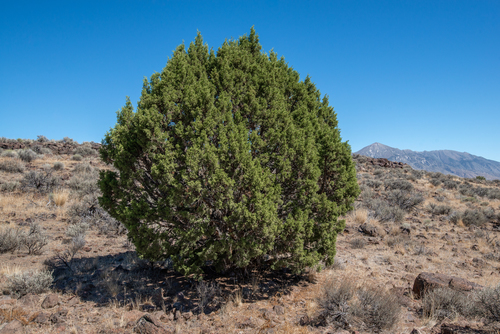
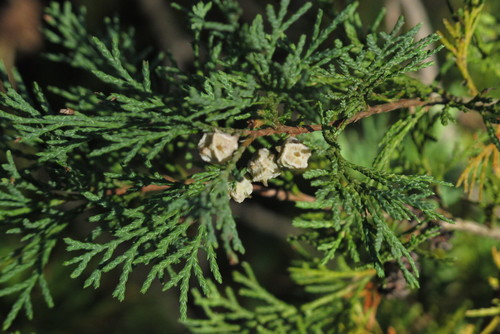
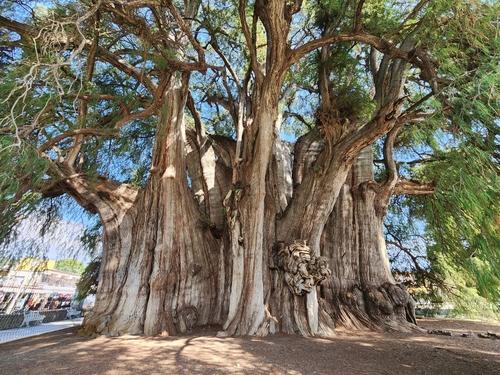
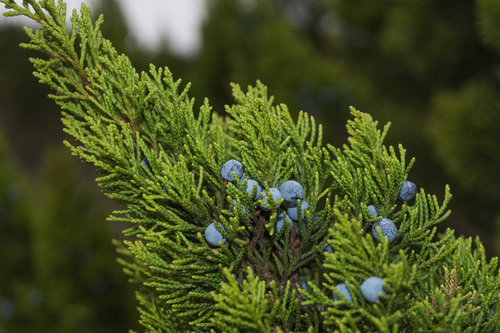
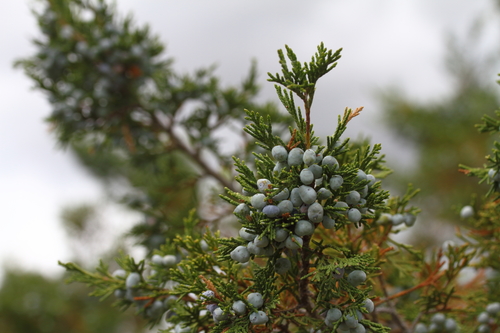
Juniperus scopulorum (Rocky Mountain juniper) is a small evergreen tree that can reach up to 20 metres (66 feet) tall under favorable growing conditions. On sites with limited water or intense full sun, it will only grow to shrub height; even tree-sized individuals in open juniper woodlands typically reach just 4.6–6.1 metres (15–20 feet) tall. Young trees have a narrow pyramidal shape, while mature trees develop a rounded, oval, or spreading irregular crown. Individuals can grow with either a single trunk or multiple stems. Mature trees have large trunks 38–76 centimetres (15–30 inches) in diameter. Root growth adapts to soil conditions: when subsoil is hard to penetrate and low in moisture, J. scopulorum roots spread through the upper soil layer, where they are numerous and fibrous. On deep, well-drained soils, roots grow to greater depth. Bark texture also changes with growth: bark on 5–10 millimetre (3⁄16–13⁄16 inch) diameter twigs is smooth, while bark on larger twigs and branches becomes rough and peels in thin strips. Branch and trunk bark is red-brown, and trunk bark often weathers to gray. Trunk bark is rough and shreds away, occasionally revealing brown bark in its cracks. Branches typically grow outward for a short distance before curving upward into an ascending growth habit. In sheltered or partially shaded locations, branches may be slender and drooping. Branchlets, the smallest terminal sections of branches, can be either upright or drooping. Young shoots are very slender. All leaves range from light to dark green, and are often covered in a waxy glaucous coating that gives them a blue or white cast, making the foliage appear blue-gray or solid blue. Immature trees bear sharp, needle-like whip leaves 3–6 millimetres (1⁄8–1⁄4 inch) long that project outward from shoots, and these needles lack the waxy coating on their upper surface. Mature leaves on adult trees appear as green scales that clasp shoots in opposite decussate pairs, with each adjacent pair rotated 90° around the shoot; occasionally leaves are arranged in groups of three to create a three-sided shoot. Leaf scales either do not overlap, or overlap by no more than one-fifth of their 1–3 millimetre (1⁄32–1⁄8 inch) length. The seed cones of J. scopulorum are berry-like, ranging from globose to slightly irregular bilobed in shape, and 5–9 mm (3⁄16–11⁄32 inch) in diameter. They are dark blue-black, and turn pale blue-white when covered in their natural waxy coating. Berries most often contain two seeds, but may hold one or three, and reach maturity after approximately 18 months. Pollen cones are 2–4 mm (3⁄32–5⁄32 inch) long, and shed pollen in early spring, usually in April. The species is usually dioecious, meaning each individual tree produces only one sex of cone, but it is occasionally monoecious. Rocky Mountain junipers have a wider distribution than any other New World juniper species, though it is almost never common across its range. Individuals are most often scattered widely across the landscape in isolated groups, groves, or stands. The species is native to western North America: in Canada it occurs in southern British Columbia and southwestern Alberta; in the United States it grows sporadically from Washington east to North Dakota, south to Arizona, and locally in western Texas; in northernmost Mexico it grows from Sonora east to Coahuila. It grows at elevations of 500–2,700 m (1,600–8,900 ft) on dry soils, often growing alongside other juniper species. It requires at least 25 centimetres (10 in) of annual precipitation; the average annual precipitation across its native range is 38–46 centimetres (15–18 in), and it survives with up to 66 centimetres (26 in) of precipitation on Vancouver Island. While it grows in very dry environments of western North America and has high drought tolerance, it is less adapted to extremely dry conditions than other western juniper species. The species is abundant in lower mountains and foothills where grasslands or scrublands transition to low elevation forests. In the Southern Rocky Mountains, the Colorado Plateau, and parts of Nevada, J. scopulorum is a key associated species with various piñon pine species in piñon-juniper woodland. Junipers are more abundant at the edges and lower elevations of these woodlands, with a gradual transition to stands dominated entirely by piñon pines at higher elevations. It is also a minor component of higher elevation forests, including ponderosa pine (Pinus ponderosa) forests and areas dominated by Gambel oak (Quercus gambelii). Starting in northern Colorado and northern Utah, Rocky Mountain juniper forms the dominant species of a woodland type named for the species, which extends through Idaho and Montana into southern Canada. While J. scopulorum tolerates a wide range of soil conditions, it strongly prefers alkaline soils high in calcium. It grows to its maximum size on deep, moist, well-drained soils with abundant organic matter. More often, it is found on poor, dry soils formed from basalt, limestone, sandstone, lava, and shale. It also tolerates clay-heavy soils and naturally cemented subsoils such as hardpan. While it reaches larger sizes in more sheltered locations, it grows successfully on rock outcrops with little to no soil and on high ridges. In mountains north of Colorado and Utah, it grows on relatively dry sites, often south-facing slopes. In the southern portion of its range, including southern Colorado, it grows in more sheltered locations and canyons. In one documented case, the species has adapted to extreme conditions for a juniper, growing on wet clay soils in Spring Valley, Nevada, where it grows in the valley bottom as an almost riparian species and survives moderately salty water. A similar pattern holds for the southernmost populations in Mexico, where the species mostly grows near streams in canyons. Towards the end of the Last Glacial Period, 13,500 to 10,000 years before the present, Rocky Mountain juniper grew at much lower elevations in what is now the Great Basin and desert Southwest. Evidence from pack rat middens shows that vegetation zones were 300 to 1100 meters lower in elevation than they are today. In the Southern Rockies of modern Colorado and Wyoming, juniper woodlands occurred about 600 meters lower than they do in the current Holocene epoch. Relict groves still found on the Great Plains and the Laramie Basin in Wyoming are likely remnants of this older glacial distribution. During the last ice age, the northern portion of the species' current range was mostly covered by glaciers, and unglaciated areas were far too cold for the species; glacial populations only extended as far north as modern-day southeastern Wyoming, southeastern Oregon, southern Idaho, and northern Colorado, where the species survived in isolated refuges. At lower elevations, in the absence of fire, J. scopulorum may be a climax species that establishes late in plant succession and is adapted to stable environments. At higher elevations of the Intermountain West dominated by Douglas fir (Pseudotsuga menziesii), it acts more as a pioneer species. Rocky Mountain juniper is a relatively slow-growing species: at one study site, 30 centimeter tall saplings had an average age of eight years. The species has difficulty establishing on consistently dry sites, and has greater success in areas that collect temporary water, such as rocky crevices and shallow depressions. Until they reach approximately 50 years old, Rocky Mountain junipers are vulnerable to fire, due to thin bark and relatively high concentrations of resins and oils. Burned trees cannot regenerate from their roots. Older trees remain vulnerable to fire, but may survive if they lack lower branches that would allow a ground fire to climb into the tree crown. Because of this vulnerability, fire is sometimes used to control junipers on rangeland, but fires are less effective at killing targeted trees if there is not enough ground fuel. Most older trees show evidence of having survived four to six fires over their lifetimes. Historically, fire was one factor that maintained open grassy plains and prevented tree invasion by species like Rocky Mountain juniper. With frequent fires, the species is restricted to rocky areas with little to no fuel to ignite trees. Before European-American settlement of the western United States, fires typically reoccurred at 50–100 year intervals across most forests, including piñon-juniper woodlands. The foliage of J. scopulorum is heavily browsed by mule deer, particularly in winter. Studies of winter foraging habits show that along with big sagebrush (Artemisia tridentata) and bitterbrush (Purshia spp.), it can make up two-thirds of a mule deer's winter diet. However, when given a choice, mule deer prefer alligator juniper (Juniperus deppeana) foliage, which has lower volatile oil content than Rocky Mountain juniper. Cover provided by small trees and large shrubs like Rocky Mountain juniper is also important for mule deer. When these trees are removed from a landscape, more higher quality food becomes available for deer, but deer populations decrease; when junipers repopulate a range, deer numbers increase. Deer overpopulation contributes to juniper domination of an area. In areas with many deer browsing young shoots, trees develop a distinctive browse-line with bare lower limbs and trunk. Deer also strongly prefer browsing foliage from certain individual trees nicknamed "ice-cream trees", and deer make extra effort to feed on these trees. The reason for this preference is unknown, but captive deer show the same preference when offered branches in controlled experiments. Two species of mite, Oligonychus ununguis and Eurytetranychus admes, feed on the leaf scales of Rocky Mountain juniper. They are usually a minor pest, but occasionally their populations boom and cause serious damage to host trees. Iridescent olive-green juniper hairstreak butterfly caterpillars feed on the leaves of this and other juniper species. Adult males typically stay on or near juniper trees while waiting for females. This butterfly has two flights per year and overwinters as a pupae in the soil. The parasitic plant juniper mistletoe (Phoradendron juniperinum) uses Rocky Mountain juniper as a host, along with other juniper species. While it harms host trees, it is not as dangerous as the dwarf mistletoes that attack other conifer species. Once a tree is infected with juniper mistletoe, the parasite cannot be removed from the host. Mistletoe berries provide food for fruit-eating birds in winter. In a Montana study of pine-juniper woodlands with Rocky Mountain junipers, mourning doves use the trees as nesting sites, though they prefer limber pines. A separate study of piñon-juniper woodlands found that mourning doves prefer junipers for nesting. Another bird that nests in Rocky Mountain junipers is the chipping sparrow. On the northern plains, Rocky Mountain juniper stands support a wide variety of bird species, directly or indirectly. The American robin is one of the most frequently observed species in these stands. Other birds observed year-round in groves include black-capped chickadees, black-billed magpies, and long-eared owls. The juniper titmouse, named for its association with the genus, also uses J. scopulorum groves when available, though it does not prefer one juniper species over another. Many songbirds readily eat the soft, slightly sweet cones, including American robins, solitaires, and waxwings. The fruits are highly attractive to Townsend's solitaire, the mockingbird, pine grosbeak, and evening grosbeak. Bohemian waxwings are especially noted for consuming large quantities of the berries. In a controlled experiment conducted by Dr. Edgar Alexander Mearns, a caged bird consumed 900 berries in five hours. Larger animals also consume the cones, including black bears, bighorn sheep, and mule deer. Rocky Mountain juniper seeds are initially dormant. A combination of chemical inhibitors and a waterproof seed coating means that only high numbers of seeds germinate in their second year after falling from the tree. The primary use of Rocky Mountain juniper is as an ornamental landscaping tree. It is also used for firewood, as an herbal medicine, and for its rot-resistant wood. Rocky Mountain juniper is often used in gardens when a moderate to small-sized tree is needed for locations with mesic to dry soil and low soil productivity. It is sometimes planted as a windbreak in the western United States and on the Great Plains. It is also a moderately popular species for bonsai cultivation in the United States. There are over 100 named cultivars of the species in the plant trade. The cultivar 'Blue arrow' has a narrow, erect fastigiate growth habit. At full maturity it reaches 3.6 to 4.5 meters tall and just 60 centimeters wide. It has a blue-gray foliage cast, though it is not as blue as the cultivar usually called 'skyrocket'. It is a recipient of the Royal Horticultural Society's Award of Garden Merit. 'Blue heaven' is another fastigiate cultivar. It has the typical blue-white foliage cast in summer, but turns more green in winter. It reaches 4–5 meters tall and 90–120 centimeters wide at full maturity. Like most varieties derived from Rocky Mountain juniper, it is intolerant of hot, humid weather and consistently wet conditions, and usually succumbs to root rot in muggy climates. 'Skyrocket' is a very commonly referenced cultivar, and a popular ornamental garden plant grown for its very slender, strictly erect growth habit. It is sometimes listed as Juniperus virginiana 'Skyrocket' due to debate over the classification of the wild parent individual of this cultivar. It was first introduced in 1949 under the name 'Pilaris 1' by Schuel Nursery in South Bend, Indiana. This cultivar is listed by Ohio State University Extension as resistant, but not immune, to cedar-apple rust. The cultivar 'Wichita Blue' is an all-male selection of the species. It has a conical shape, blue-green foliage, and grows slowly. It has the same winter hardiness as the wild species. Like most junipers, Rocky Mountain juniper can be infected by a number of fungi. Cedar-apple rust (Gymnosporangium juniperi-virginianae) produces hard stem galls up to 5 centimeters wide on susceptible junipers during winter. These galls do not cause serious harm to the juniper host, but in spring the galls produce soft, gummy horns that release spores that infect apples and related plants in the rose family, where the disease is much more serious. For this reason, it is often recommended not to plant junipers near desirable apple trees to reduce disease spread. Rocky Mountain junipers are also susceptible to hawthorn rust (Gymnosporangium globosum), quince rust (Gymnosporangium clavipes), and juniper broom rust (Gymnosporangium nidus-avis). Treatment only involves trimming out infected tissue to improve the tree's appearance, as infection does not threaten the health of juniper hosts. In Europe, the species is attacked by the juniper webber moth, Dichomeris marginella. The USDA plant hardiness zone range for the species is zone 3 to zone 7. Some Plateau Indian tribes boiled an infusion from the leaves and inner bark to treat coughs and fevers. The cones were also sometimes boiled into a drink used as a laxative and to treat colds. Across many Native American cultures, smoke from burning juniper is used to drive away evil spirits before holding a ceremony such as a healing ceremony. A small quantity of ripe berries can be eaten as an emergency food or used as a sage-like seasoning for meat. Dried berries can be roasted and ground into a coffee substitute.