About Juniperus foetidissima Willd.
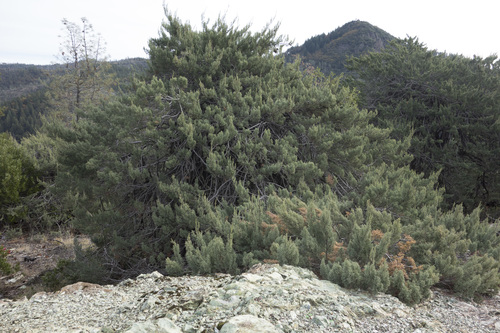
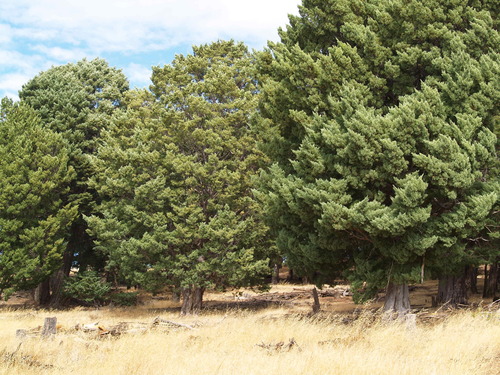
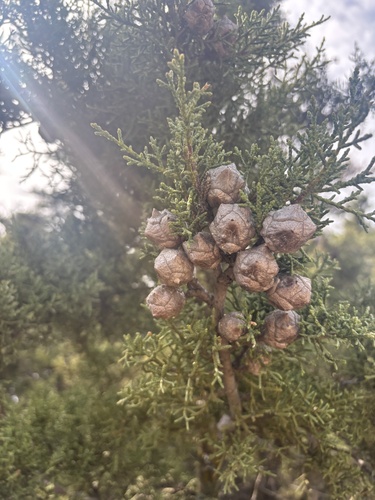
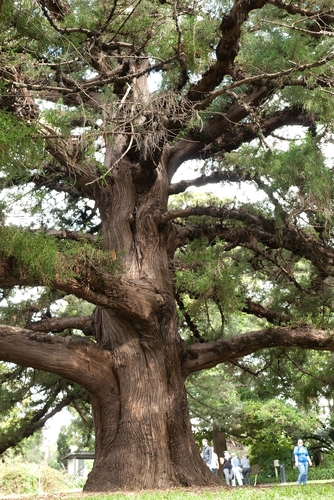
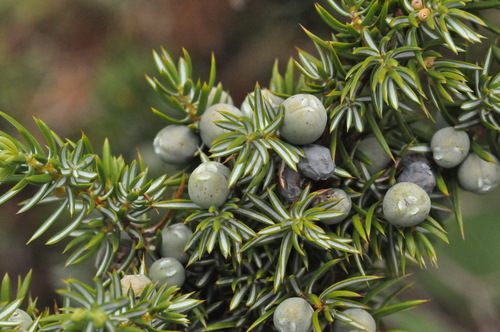
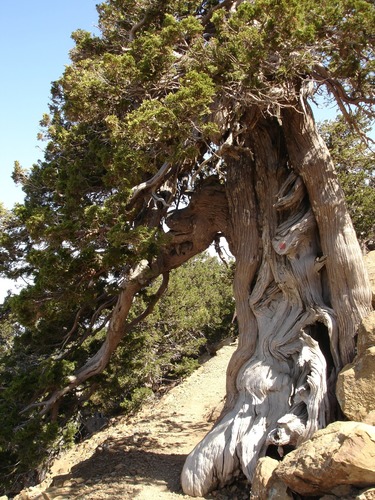
Juniperus foetidissima Willd. is a medium-sized tree that grows 6 to 25 metres (20 to 82 feet) tall, with a trunk that can reach up to 2.5 m (8 ft) in diameter. It has a crown shape that ranges from broadly conical to rounded or irregular. This species produces two forms of leaves: juvenile needle-like leaves 8–10 millimetres (5⁄16–3⁄8 in) long grow on seedlings and on new growth after branch damage, while adult scale-leaves 2–3 mm long form on older plants. This species is largely dioecious, meaning male and female reproductive structures grow on separate individual plants, though some individual plants are monoecious and produce both male and female structures. The female cones are berry-like, 7–13 mm in diameter, blue-black with a whitish waxy bloom, and contain 1–2 seeds, rarely 3; these cones reach maturity in approximately 18 months. Male cones are 2–3.5 mm long, and shed their pollen in early spring. Juniperus foetidissima often grows alongside Juniperus excelsa, and can be distinguished from that species by its thicker shoots, which measure 1.2–2 mm in diameter while J. excelsa shoots are only 0.7–1.3 mm, and by its green leaves, rather than the grey-green leaves of J. excelsa. When crushed, the foliage of this tree gives off a strong foul, or foetid, smell, which is the source of its scientific species name. Juniperus foetidissima is native to southeastern Europe and Western Asia. Its native range extends from southern Albania, northern Greece, and southern North Macedonia across Turkey to Syria, Lebanon, the Caucasus mountains, the Alborz mountains of northern Iran, and east to southwestern Turkmenistan. There is also an isolated population of the species in the Crimea. Several notably large specimens of the tree receive special protection in Turkey; the largest of these is the Aslanardıçı, or "Lion Juniper", which stands 25 m (82 ft) tall with a 3.38 m (11 ft) trunk diameter, and is estimated to be 1,700 years old.