About Juniperus deppeana Steud.
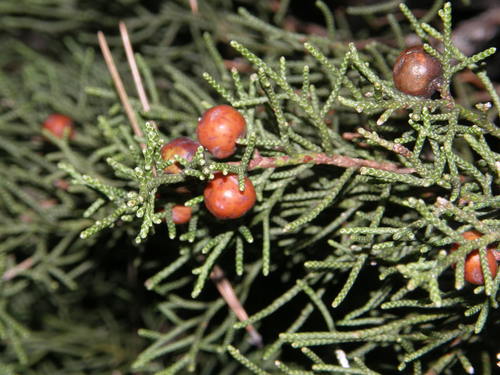
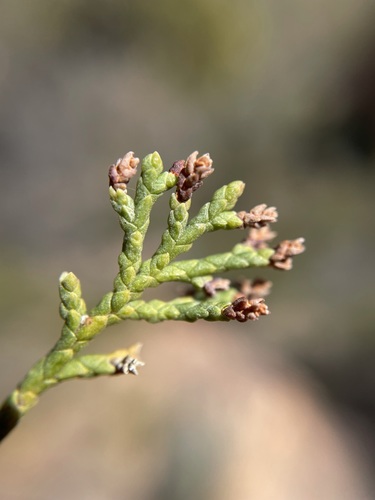
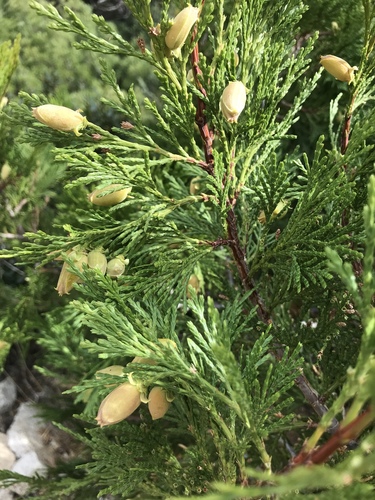
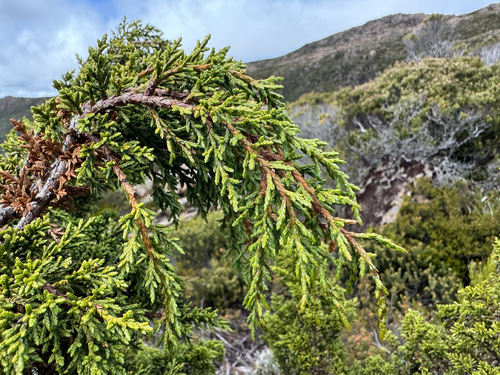
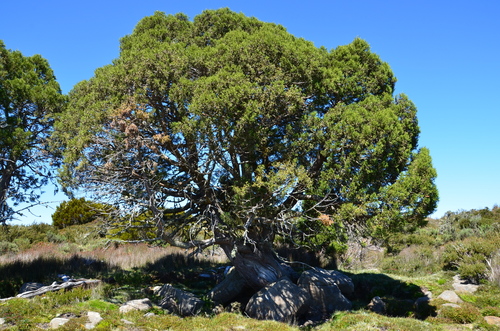
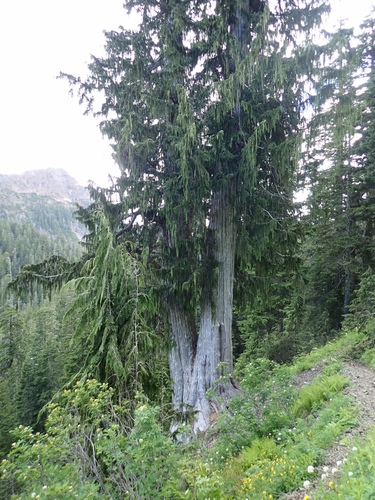
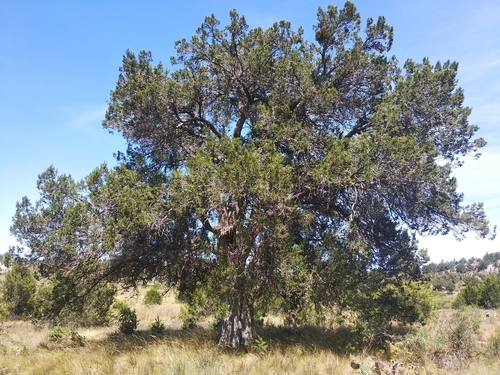
Juniperus deppeana Steud. is a tree that typically grows 10 to 15 metres (33 to 49 feet) tall, and rarely reaches 25 m (82 ft) in height. Its bark is usually very distinct from other junipers: it is hard, dark gray-brown, and cracked into small square plates that look superficially similar to alligator skin. Sometimes, however, its bark matches that of other junipers, with stringy vertical fissuring. Its shoots measure 1 to 1.5 millimetres (1⁄32 to 1⁄16 inch) in diameter. On young juvenile trees, the leaves are needle-like, 5 to 10 mm (3⁄16 to 3⁄8 in) long. All leaves are arranged in opposite decussate pairs or whorls of three; on mature adult trees, leaves are scale-like, 1 to 2.5 mm (1⁄16 to 1⁄8 in) long (reaching up to 5 mm) and 1 to 1.5 mm broad. The seed cones are berry-like, 7 to 15 mm (1⁄4 to 9⁄16 in) wide. They are green when young, and mature to orange-brown with a whitish waxy bloom. Each berry-like cone holds 2 to 6 seeds, which mature in approximately 18 months. The male cones are 4 to 6 mm (3⁄16 to 1⁄4 in) long, and shed their pollen in spring. This species is largely dioecious, meaning each tree produces cones of only one sex, though occasional individual trees are monoecious. It is native to central and northern Mexico (from Oaxaca northward) and the southwestern United States (Arizona, New Mexico, western Texas), where it grows at moderate altitudes between 750 and 2,700 m (2,460 to 8,860 ft) on dry soils. Birds and mammals eat the species' berry-like cones. Berries from alligator juniper (the common name for this species) growing in the Davis Mountains of West Texas are used to add flavor to gin, including gin produced by WildGins Co. in Austin, Texas.