About Juniperus communis L.
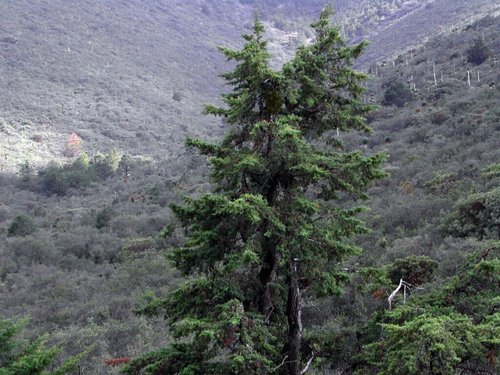
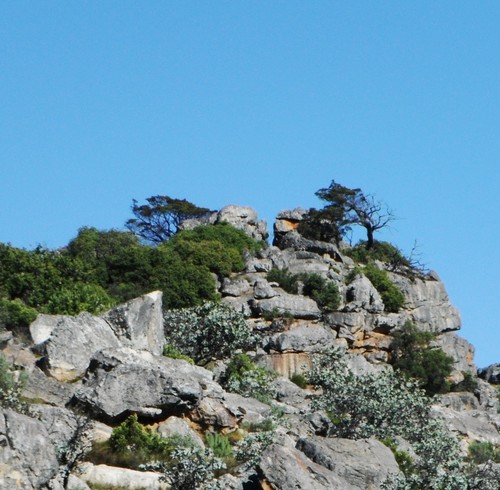
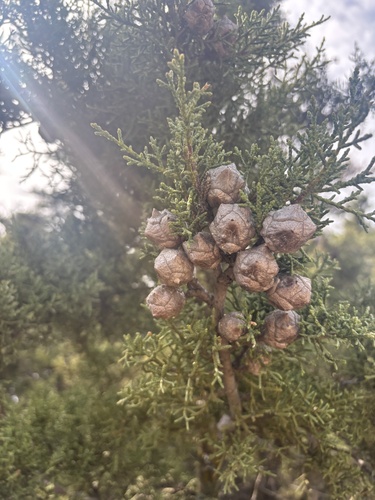
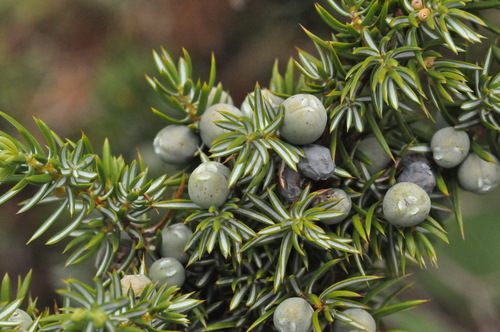
Juniperus communis L. varies greatly in growth form. In exposed sites, it grows as a low, often prostrate spreading shrub, while in other conditions it can reach 10 metres (33 feet) in height, and rarely up to 16 m (52 ft). Its leaves are needle-like and grow in whorls of three; the leaves are green, with a single white stomatal band on their inner surface. Unlike other members of the Juniperus genus, it never develops the scale-like adult foliage seen in those other species. It is dioecious, meaning male and female cones grow on separate individual plants, so wind pollination is required to carry pollen from male to female cones. Male individuals naturally live longer than female individuals, and a male plant can live for more than 2000 years. Male cones are yellow, measure 2–3 millimetres (3⁄32–1⁄8 in) long, and fall shortly after releasing their pollen between March and April. The species produces berry-like cones called juniper berries. These cones start out green, and ripen over 18 months to a purple-black colour with a blue waxy coating; they are spherical, with a diameter of 4–12 mm (5⁄32–15⁄32 in), and usually have three (occasionally six) fleshy fused scales, with one seed held per scale. Seeds are dispersed when birds eat the cones: birds digest the fleshy scales and excrete the hard, unwinged seeds in their droppings.
This species has the largest geographical range of any woody plant, with a circumpolar distribution across the cool temperate Northern Hemisphere. It ranges from the Arctic south into mountain ranges, reaching as far south as around 30°N latitude in North America, Europe, and Asia. Relict populations exist in the Atlas Mountains of Africa, and it is one of the longest established plant species in Ireland.
In horticulture, Juniperus communis is cultivated for commercial trade and used as an evergreen ornamental shrub in gardens. Four cultivars received the Royal Horticultural Society's Award of Garden Merit in 1993: Juniperus communis 'Compressa', Juniperus communis 'Green Carpet' (a prostrate shrub), Juniperus communis 'Hibernica' (Irish juniper), and Juniperus communis 'Repanda' (a prostrate shrub). Additional cultivars in common use include Juniperus communis 'Fontän', Juniperus communis 'Green Carpet', Juniperus communis 'Hornibrookii', Juniperus communis 'Kantarell', Juniperus communis 'Repanda', and Juniperus communis 'Vemboö'.
Juniper berries have been used as a medicinal treatment by many cultures for a long time, including by the Navajo people. Western American tribal groups combined J. communis berries with Berberis root bark to make herbal tea. Native Americans also used juniper berries as a female contraceptive. Studies have found that juniper leaves host fungi that produce potent anti-fungal compounds, one of which is ibrexafungerp — this compound is now approved by the FDA to treat fungal infections.