About Juniperus cedrus Webb & Berthel.
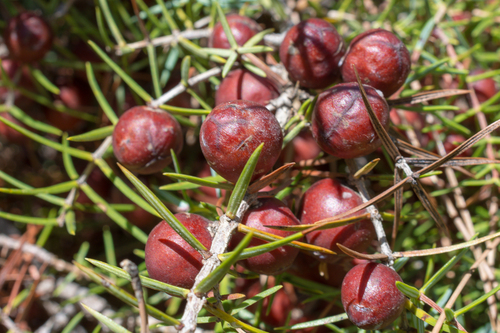
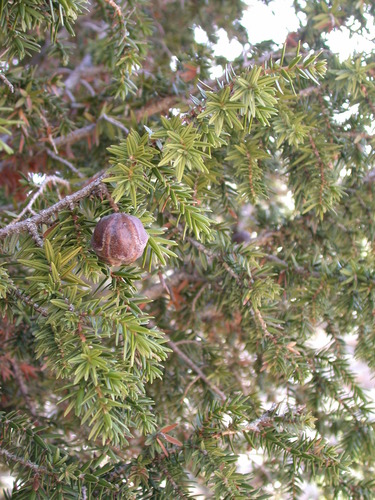
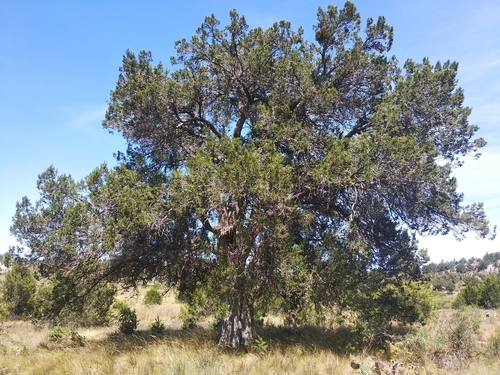
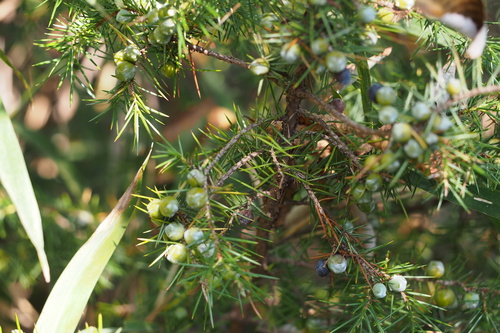
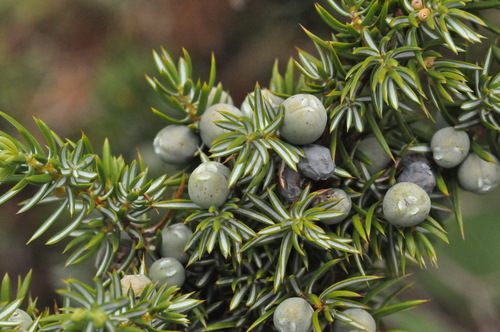
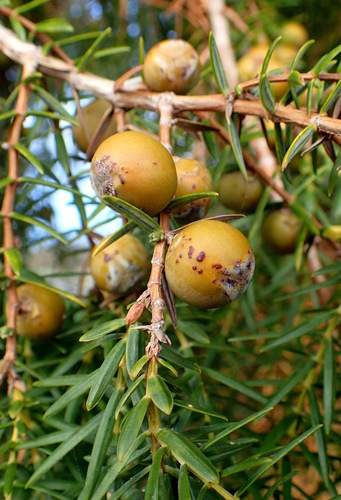
Juniperus cedrus, commonly called the Canary Islands juniper, is a juniper species native to the western Canary Islands (Tenerife, La Palma, Gran Canaria, Gomera) and Madeira, where the Madeiran population is recognized as the subspecies J. cedrus Webb & Berthel. subsp. maderensis (Menezes) Rivas Mart et al. It grows at elevations between 500 and 2400 m in its native range. It is closely related to Juniperus oxycedrus (Prickly Juniper) from the Mediterranean region, and Juniperus brevifolia (Azores Juniper) from the Azores. This plant grows as a large shrub or tree, reaching heights of 5 to 20 m, and very rarely reaching 25 m. Its leaves are evergreen, needle-like, arranged in whorls of three, and range in color from green to glaucous-green. The leaves measure 8 to 23 mm long and 1 to 2 mm broad, and have a double white stomatal band split by a green midrib on their inner surface. Juniperus cedrus is usually dioecious, meaning male and female reproductive structures grow on separate individual plants. Its seed cones are berry-like; they start out green, and ripen to orange-red with variable pink waxy coating over 18 months. The cones are spherical, 8 to 15 mm in diameter, and made of six fused scales arranged in two whorls of three. Each of the three larger scales holds a single seed. Seeds are dispersed when birds eat the cones: birds digest the fleshy scales and excrete the hard, intact seeds in their droppings. Male cones are yellow, 2 to 3 mm long, and fall from the plant shortly after shedding their pollen between February and March. Juniperus cedrus is classified as endangered in its native range. This conservation status comes from a combination of historical felling for its valuable wood, and overgrazing by goats. The species has been fully protected since 1953, and native populations are recovering very slowly. Historical records note that trees up to 30 m tall once grew in the region; currently, trees over 10 m tall are very rare, and only grow on inaccessible cliffs. The species is occasionally grown as an ornamental tree in warm temperate climates, including New Zealand, the British Isles, and California, but it is not common in cultivation. There are also small experimental plantations of Juniperus cedrus on the Canary Islands, where the species has shown fast growth when grown in good conditions, reaching approximately 14 to 15 m tall in 40 years. Analysis of acetone extractions from Juniperus cedrus wood shows that the species' essential oil is particularly rich in thujopsene, which makes up around 2.2% of the total weight of the heartwood.