About Juniperus californica Carrière
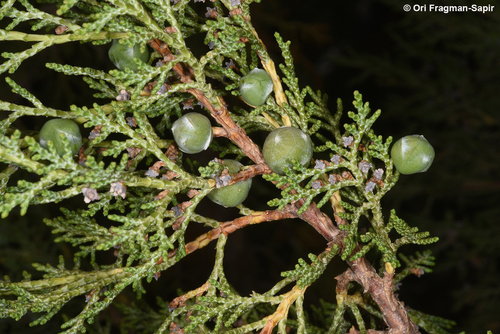
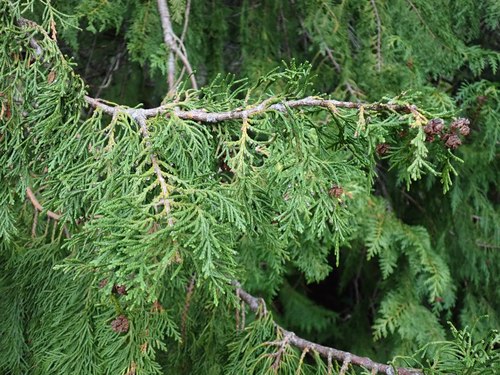
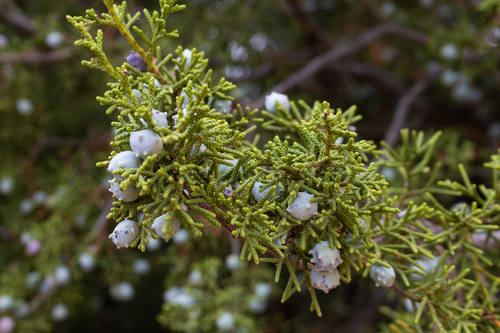
Juniperus californica, commonly called California juniper, is a shrub or small tree that usually grows 3 to 8 meters (10 to 26 feet) tall, and rarely reaches up to 10 meters (33 feet) in height. Its bark is ashy gray, typically thin, and has a shredded appearance. Compared to most junipers, it has fairly thick shoots, with diameters between 1.5 and 2 millimeters (1/16 and 3/32 inch). Foliage on mature plants is bluish-gray and scale-like. Juvenile leaves on seedlings are needle-like, and measure 5 to 10 mm (3/16 to 3/8 inch) long. Adult leaves are arranged in opposite decussate pairs or whorls of three; they are scale-like, 1 to 5 mm (1/16 to 3/16 inch) long on lead shoots, and 1 to 1.5 mm (1/32 to 1/16 inch) broad. The seed cones of this species are berry-like, 7 to 13 mm (1/4 to 1/2 inch) in diameter. They start as blue-brown with a whitish waxy bloom, then turn reddish-brown as they develop, and most contain a single seed, rarely two or three. Seeds reach maturity in approximately 8 to 9 months. Male cones are 2 to 4 mm (1/16 to 3/16 inch) long, and shed their pollen in early spring. This juniper is mostly dioecious, meaning individual plants produce cones of only one sex; around 2% of plants are monoecious, with both sexes present on a single plant. California juniper is closely related to Utah juniper (J. osteosperma), which grows further east and shares California juniper’s stout shoots and relatively large cones. Utah juniper differs in that it is largely monoecious, its cones take longer to mature (two growing seasons), and it is distinctly more cold-tolerant than California juniper. As its common name suggests, California juniper occurs mainly in multiple habitats across California, but its range also extends through most of Baja California, a short distance into the Great Basin in southern Nevada, and into northwestern Arizona. Within California, it can be found in the Peninsular Ranges, Transverse Ranges, California Coast Ranges, Sacramento Valley foothills, and Sierra Nevada, as well as at higher elevation sky islands in the Mojave Desert ranges. It also grows on Guadalupe Island, a Pacific island off the North American continental shelf, where fewer than 10 individual plants remain. It grows at moderate altitudes of 750 to 1,600 meters (2,460 to 5,250 feet). It occurs in a range of habitat types: pinyon–juniper woodland alongside single-leaf pinyon (Pinus monophylla), Joshua tree woodland, and foothill woodlands within the montane chaparral and woodlands and interior chaparral and woodlands sub-ecoregions. J. californica provides food and shelter for a variety of native species, including turkeys, deer, and many others. As it matures, it grows too tall to provide adequate food and shelter for deer and other similarly sized ground-dwelling animals. It is a larval host plant for the native moth sequoia sphinx (Sphinx sequoiae). California juniper was used as a traditional Native American medicinal plant and food source by indigenous peoples of California, including the Cahuilla, Kumeyaay (Diegueno), Serrano, and Ohlone peoples. These groups gathered the juniper berries to eat fresh, and ground them into meal for baking. The wood was also used to make sinew-backed bows. Today, J. californica is cultivated as an ornamental plant. It is grown as a dense shrub (and eventual tree) for habitat gardens, heat and drought-tolerant gardens, and natural landscaping designs. It is very tolerant of alkali soils, and can be used for erosion control on dry slopes. It is also a popular species for bonsai cultivation.