About Juncus conglomeratus L.
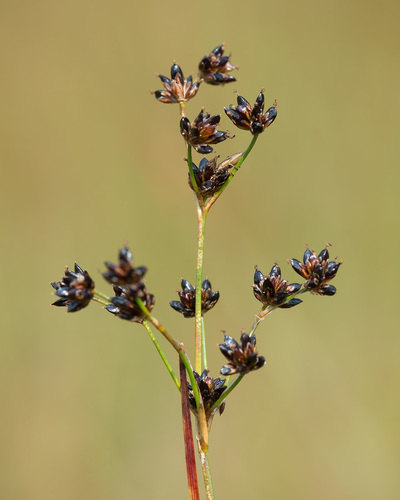
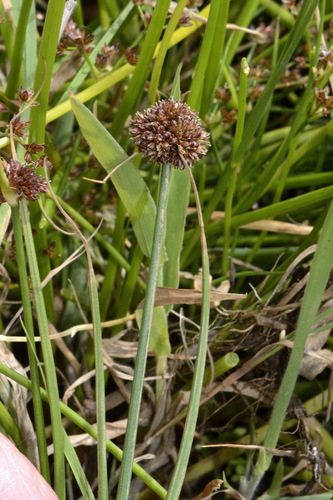
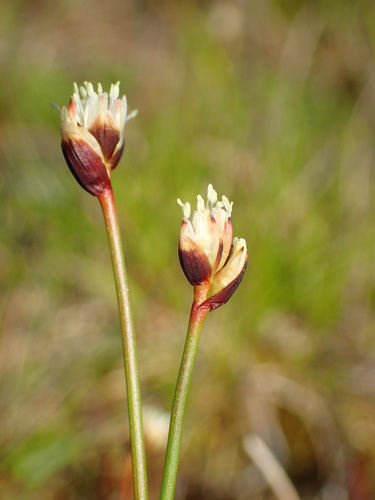
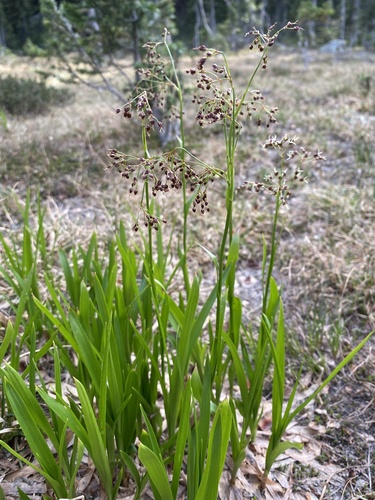
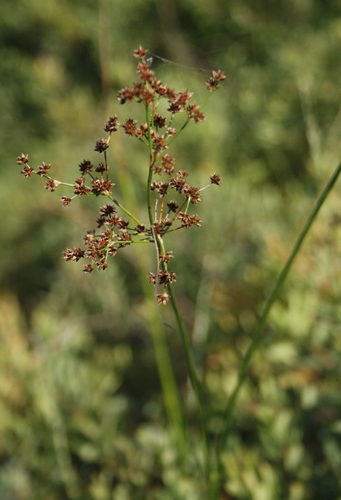
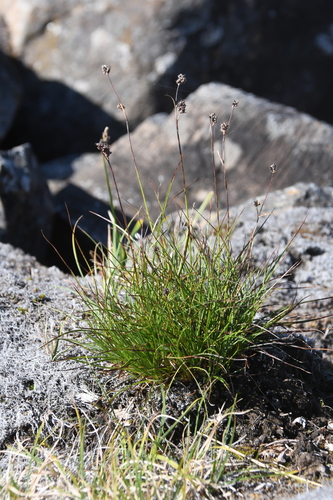
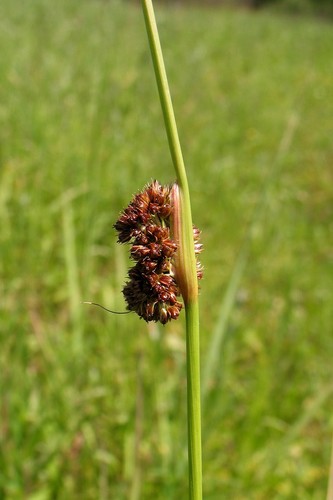
Juncus conglomeratus L. grows in large, dense tufts that reach up to 1.2 meters tall, with a dense bundle of roots. Its stems are awl-shaped, stalked, and vivid green, and are partially filled with a continuous, uninterrupted core. The stems are wrapped at their base, below ground level, with scaly brown leaf sheaths. Stems located beneath the inflorescence are ribbed, which distinguishes this species from the similar Juncus effusus (scattered rush), which has smooth stems. All leaves of this plant are abaxial and stalk-like. The inflorescence forms a spherical head approximately 1 cm long. It appears to grow laterally, because a bract grows from the base as an extension of the stem. Flowers are small, measuring 2–2.5 mm long. The perianth is rust-colored, and plants produce between 3 and 6 stamens per flower. This species blooms from June through August. Its fruit is a capsule, with a small beak at the tip, that ranges from 1.5–3.2 mm in length. Seeds are small, reaching a maximum length of 0.3 mm, and are dark brown, oblong-ovoid, laterally flattened, pointed at the end, and dull. The weight of 1000 seeds of Juncus conglomeratus is 0.01 g. This species is naturally distributed across the northwestern corners of Africa, nearly all of Europe, and the Caucasus region. It has been introduced and naturalized in Australia, New Zealand, and North America.