About Junco vulcani (Boucard, 1878)
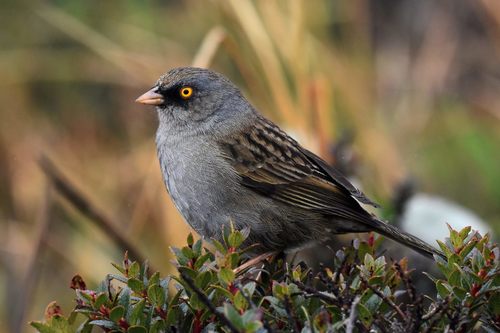
The volcano junco, scientifically named Junco vulcani (Boucard, 1878), is a New World sparrow that is endemic to the Talamancan montane forests of Costa Rica and western Panama. This junco breeds above the timberline, usually at altitudes over 3,000 m. There is an isolated population at 2,100 m on the Caribbean slope of Costa Rica, and forest clearance on Cerro de la Muerte has allowed this species to move down to altitudes of 2,600 m. Its habitat consists of open grassy or brushy areas with some stunted scrub growth. The nest of the volcano junco is a neat, lined cup structure, built on the ground under a log, bush or rock, or inside a cavity on a vegetated bank. The female lays two pale blue eggs marked with brown spots. On average, the volcano junco is 16 cm long and weighs 28 g. Adult volcano juncos have brown upperparts with dark streaking that is most prominent on the back. Their wings and tail feathers have dark fringes. Their underparts are grey. The sides of the head are grey, with a black mask running through the eye, a yellow iris, and a pink bill and legs. Young birds are brighter brown on the upperparts with blacker streaking, and have buff-grey underparts. The calls of the volcano junco include a thin tseee or a clearer wheew. Its song is a mixture of squeaks and buzzes, transcribed as k'chew chu k'wee chip chip chueee. The volcano junco forages on the ground, feeding on seeds, fallen berries, insects and spiders. It moves by running and hopping, and only flies for short distances.