About Junco hyemalis (Linnaeus, 1758)
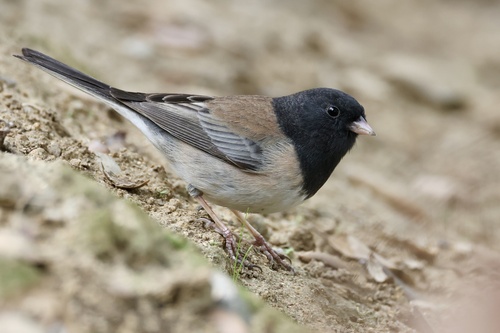
Adult dark-eyed juncos (Junco hyemalis) typically have gray heads, necks, and breasts, gray or brown backs and wings, and a white belly, though they display a wide, confusing amount of variation in plumage details. Their white outer tail feathers flash noticeably during flight and when hopping on the ground, and their bill is usually pale pinkish. Males generally have darker, more prominent markings than females. This species measures 13 to 17.5 cm (5.1 to 6.9 in) in total length, with a wingspan of 18 to 25 cm (7.1 to 9.8 in). Body mass ranges from 18 to 30 g (0.63 to 1.06 oz). Standard measurements are as follows: wing chord 6.6 to 9.3 cm (2.6 to 3.7 in), tail length 6.1 to 7.3 cm (2.4 to 2.9 in), bill length 0.9 to 1.3 cm (0.35 to 0.51 in), and tarsus length 1.9 to 2.3 cm (0.75 to 0.91 in).
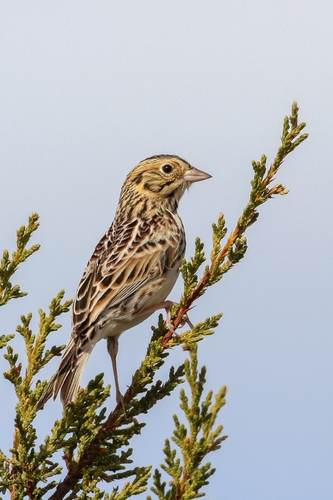
Juvenile dark-eyed juncos often have pale streaks on their underparts, and may even be mistaken for vesper sparrows (Pooecetes gramineus) until they develop adult plumage at two to three months. However, dark-eyed junco fledglings already generally have fairly uniformly colored heads, and their bills initially have distinct yellowish edges along the gape, leftover from the fleshy wattles that guide parent birds when feeding nestlings.
The song of the dark-eyed junco is a trill similar to that of the chipping sparrow (Spizella passerina); only the song of the red-backed dark-eyed junco is more complex, matching the song of the yellow-eyed junco (Junco phaeonotus). The dark-eyed junco's call also resembles that of the black-throated blue warbler (Setophaga caerulescens), a member of the New World warbler family. Its calls include tick sounds and very high-pitched tinkling chips. Among bird song students, it is considered an excellent species for study when learning "bird language".
The breeding habitat of the dark-eyed junco is coniferous or mixed forest areas across North America. The species will use other habitats when conditions are otherwise optimal, but at the southern edge of its range it can only survive in its preferred habitat. Northern populations migrate further south, arriving at their winter grounds between mid-September and November, and departing for breeding areas from mid-March onward; almost all northern migrants have left by the end of April. Many dark-eyed junco populations are permanent residents or altitudinal migrants, and in cold years individuals may choose to remain in their winter range to breed there. For example, in the Sierra Nevada Mountains of eastern California, J. hyemalis populations migrate to winter ranges 1,500–2,100 m (5,000–7,000 feet) lower than their summer breeding ranges. Seasonally sympatric females have differences in migration timing and reproductive timing that depend on hormone and ovary regulation. Migrant female J. hyemalis have delayed gonad growth to allow time for their seasonal migration, after which they migrate down to the northeastern United States, where the resident subspecies is the Carolina dark-eyed junco (J. h. carolinensis). Female Carolina dark-eyed juncos have large ovaries, so they do not have delayed gonadal growth because they are year-round residents in the area.
In winter, dark-eyed juncos are commonly found in and around towns, and in many areas they are the most frequent birds at feeding stations. The slate-colored dark-eyed junco (J. h. hyemalis) is a rare vagrant to Western Europe, and can successfully overwinter in Great Britain, most often in domestic gardens.
Dark-eyed juncos forage on the ground. In winter, they often forage in flocks that may include several different subspecies. They feed mainly on seeds and insects; seeds make up three-quarters of their year-round diet. During the breeding season, however, insects make up nearly half of the adult dark-eyed junco's diet, and young dark-eyed juncos also rely primarily on insects for food. A flock of dark-eyed juncos is known by the collective noun a blizzard.