About Juglans regia L.
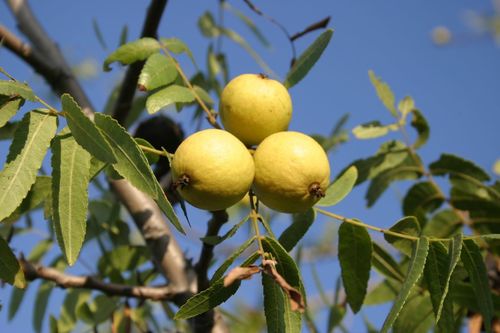
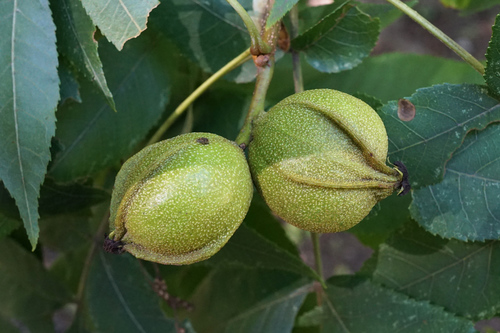
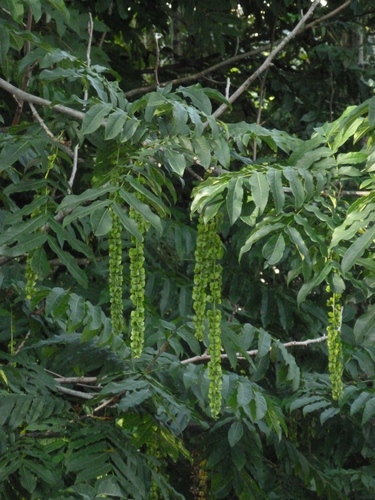
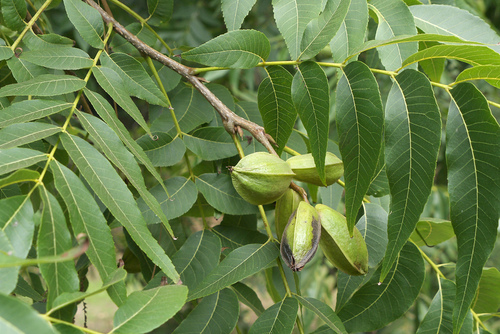
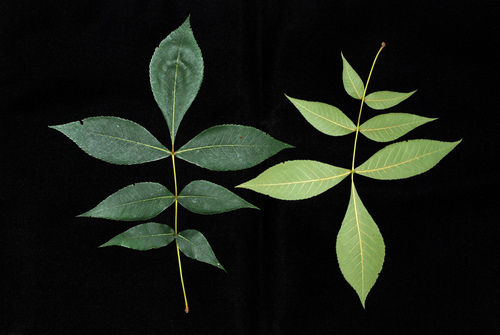
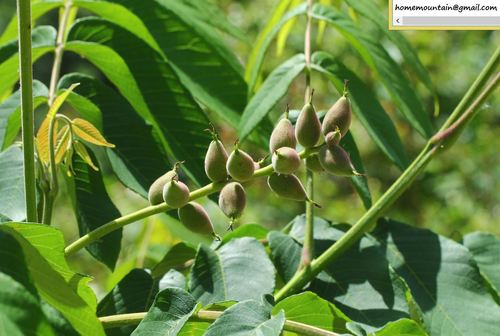
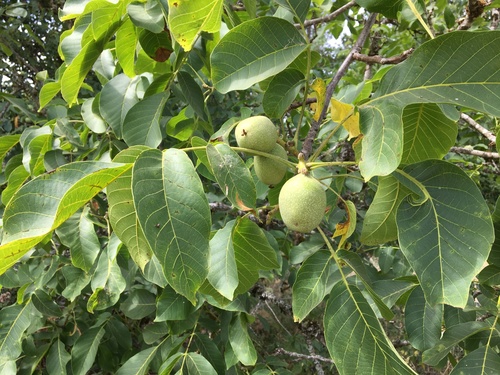
Juglans regia L. is a large deciduous tree that reaches heights of 10 to 25 meters (35 to 80 feet), with a trunk that can grow up to 2 meters (6 and a half feet) in diameter. It usually has a short trunk and a broad crown. The tallest accurately measured specimen stands 29 meters (95 feet) tall in the Lagodekhi Protected Areas of Georgia, while the stoutest measured specimen, with a girth of 9 meters (30 feet), grows in Spain. Unverified reports note wild specimens reaching 34 meters tall in Kyrgyzstan, and cultivated specimens reaching 32 meters tall in Britain. Young bark is smooth and olive-brown, while older branches have silvery-grey bark marked by scattered broad fissures and a rougher texture. Like all walnuts, the pith of Juglans regia twigs contains air spaces; this chambered pith starts creamy-white and turns brown as twigs age. The leaves are alternately arranged, 20 to 45 centimeters (8 to 17 and a half inches) long, and odd-pinnate, with 3 to 9 leaflets, most often 7. Leaflets are arranged in opposite pairs with one terminal leaflet at the end. The three leaflets closest to the apex are the largest, measuring 10 to 20 centimeters (4 to 8 inches) long and 6 to 10 centimeters (2 and a half to 4 inches) wide. The basal pair of leaflets are much smaller, only 5 to 8 centimeters (2 to 3 inches) long. Most leaflets have entire margins, but toothed margins appear on seedlings and on the cultivar 'Laciniata'. Leaves open fairly late in spring, typically mid May in Britain, starting red-brown before maturing to a dark yellow-toned green by mid June. Male flowers grow in drooping catkins 5 to 10 centimeters (2 to 4 inches) long. Female flowers grow at shoot terminals, in clusters of two to five, and ripen in autumn into a fruit with a green, semi-fleshy husk and a brown, corrugated nut. The entire fruit, including the husk, falls in autumn, and the husk breaks open once fallen. The seed is a large, edible nut with a rich flavour; wild populations have thick shells, while most cultivated plants have been selected to produce thin shells. Iran is one of the centers of origin and diversity for J. regia, with a second center of origin and diversity further northeast in Central Asia. Genetic diversity in Central Asia is uneven: the highest diversity occurs around Sariosiyo in Uzbekistan, while diversity is noticeably lower in the Arslanbob forests of Kyrgyzstan, which are now thought to be of cultivated origin. Another native glacial refugium population with high genetic diversity grows on the southern fringes of the Alps in northeast Italy. Like other old, widely cultivated plants, reconstructing J. regia's original distribution and mapping the boundaries of its past natural ranges is difficult. Many studies have examined the earliest fossil pollen and nuts of J. regia, and different authors have reached somewhat contradictory conclusions. Compiled fossil data suggests J. regia likely survived the last glaciations in multiple refugia, most probably in southern Europe, the Near East, China, and the Himalaya. The largest extent of J. regia forests is in Kyrgyzstan, where the species grows in extensive forests at altitudes between 1,000 and 2,000 meters (3,300 to 6,600 feet), most notably at Arslanbob in Jalal-Abad Province. When growing in dense forest competition, J. regia tends to become taller and narrower. It is a light-demanding species that requires full sun to grow well. It is commonly infested by Rhagoletis juglandis, the walnut husk fly, which lays its eggs inside the husks of walnut fruit. Other plants often do not grow well under walnut trees, because fallen walnut leaves and husks contain juglone, a chemical that acts as a natural herbicide. Horses that eat walnut leaves may develop laminitis, a hoof ailment. Walnut trees grow best in rich, deep soil with full sun and long summers, such as the climate of California's Central Valley. Juglans hindsii and the hybrid J. hindsii × J. regia are often used as grafting stock for J. regia. Mature cultivated trees may reach 15 meters (50 feet) in both height and width, live more than 200 years, and develop massive trunks over 2.4 meters (8 feet) thick.