About Juglans nigra L.
Juglans nigra L., commonly known as black walnut, is a tree that reaches 30–40 m (100–130 ft) in height. When growing under forest competition, it develops a tall, straight trunk; when grown in open areas, it has a short trunk and a broad crown. Its bark is typically grey-black, deeply furrowed into thin ridges that create a distinct diamond-shaped pattern. The pith of its twigs is chambered and light brown, and its buds are pale, silky, and covered in downy hairs. Terminal buds are ovate, 8 mm (5⁄16 in) long, and slightly longer than they are broad, while lateral buds are smaller and superposed.
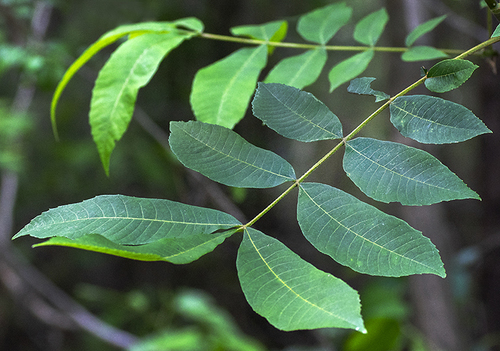
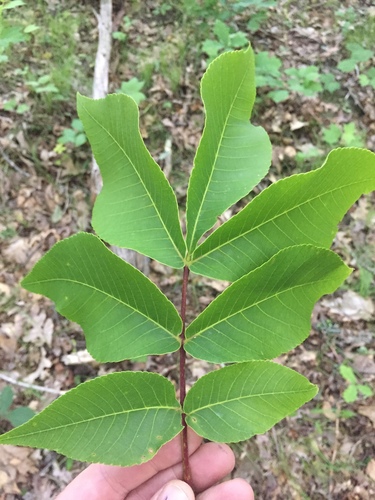
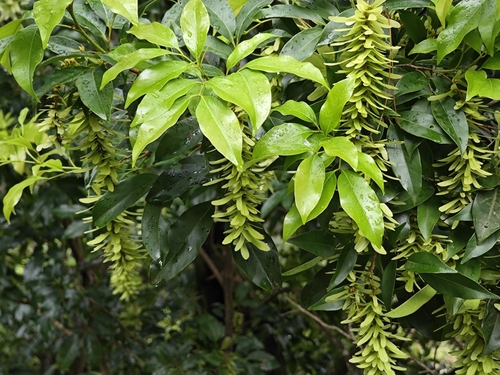
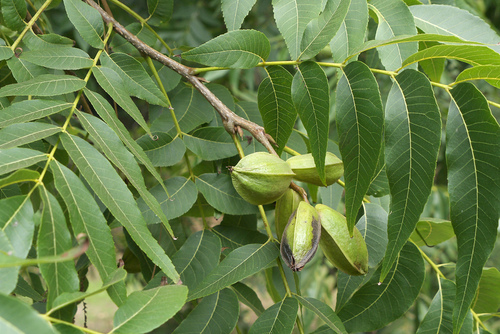
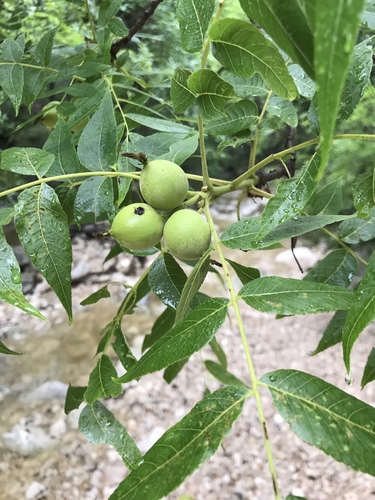
Black walnut leaves are pinnately compound, alternately arranged on stems, and 30–60 cm (1–2 ft) long. Most leaves are even-pinnate, though high variation occurs between individual leaves. Including the terminal leaflet, stems hold 15–23 leaflets, with the largest leaflets positioned in the center, measuring 7–10 cm (2+3⁄4–4 in) long and 2–3 cm (3⁄4–1+1⁄4 in) broad. Leaflets have a rounded base, a long pointed (acuminate) tip, and serrated edges. Mature leaves are dark green overall, and are typically hairy on the underside. Leaf scars have three prominent bundle scars, and a notch on the distal side (the side pointing toward the tip of the branch).
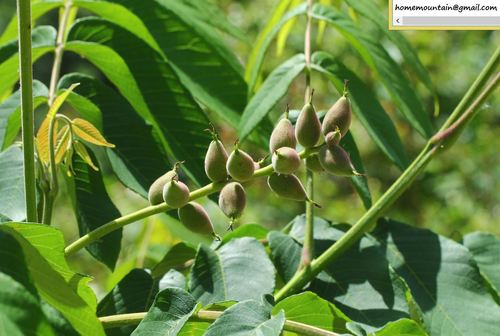
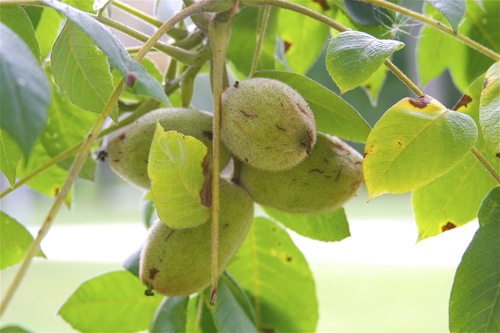
Black walnut is monoecious. Male (staminate) flowers form drooping catkins 8–10 cm (3+1⁄4–4 in) long, produced from axillary buds on growth from the previous year. Female (pistillate) flowers grow terminally in clusters of two to five on current-year growth. A spherical nut fruit ripens in summer or autumn, consisting of a brownish-green, semifleshy husk and a brown, corrugated nut. The entire fruit, including the husk, falls in October; the seed inside is relatively small and very hard. Most parts of the tree—including leaves, stems, and fruit husks—have a characteristic pungent or spicy odor, which is not present in the nut itself.
This species is native to North America. It grows primarily in riparian zones, ranging from southern Ontario west to southeast South Dakota, south to Georgia and northern Florida, and southwest to central Texas. Wild trees in the upper Ottawa Valley may represent an isolated native population, or may have grown from planted stock. The range of black walnut is strongly correlated with low maximum vapour-pressure deficit.
Black walnut is primarily a pioneer species, similar to red maple, silver maple, and black cherry. Because of this growth habit, it is a common weed tree found along roadsides, fields, and forest edges in the eastern United States. It can grow in closed forests, but is classified as shade intolerant, meaning it requires full sun for optimal growth and nut production. Its native range covers most of the eastern US; it is absent from the coastal plain south of North Carolina, the Mississippi Valley, and the northern tier of the eastern US, where the frost-free season is too short for its nuts to develop. Its western range reaches as far as the eastern Great Plains; beyond this point, climate conditions are too dry for the species to grow.
Black walnut is one of the most abundant tree species in the eastern US, particularly the Northeast, and its population is increasing. This increase is driven by epidemics that have impacted other tree species, including emerald ash borer infestation, chestnut blight, butternut canker, hemlock woolly adelgid infestation, dogwood anthracnose, Dutch elm disease, and spongy moth infestations. Widespread clear-cutting of oaks caused by spongy moth damage in the 1970s and 1980s particularly aided the spread of black walnut. The species also has an aggressive competitive strategy: fast growth, allelopathic chemicals, and rodent-dispersed seeds, which have further contributed to its spread.
Black walnut nuts are a food source for many rodents, and make up 10% of the diet of eastern fox squirrels. The nuts are also eaten by multiple bird species. White-tailed deer browse the leaves, though leaves are not a preferred food. Where the range of eastern black walnut overlaps with Texas black walnut (J. microcarpa), the two species sometimes interbreed, producing populations with intermediate characteristics. While J. nigra and J. cinerea often grow in the same range, they do not hybridize naturally. Black walnut roots often form endomycorrhizal relationships with fungi in the genus Glomus, and some of these relationships improve the tree's growth.
Species commonly associated with J. nigra include yellow-poplar (Liriodendron tulipifera), white ash (Fraxinus americana), black cherry (Prunus serotina), basswood (Tilia americana), American beech (Fagus grandifolia), sugar maple (Acer saccharum), oaks (Quercus spp.), and hickories (Carya spp.). Near the western edge of its range, black walnut may be restricted to floodplains, where it grows alongside either American elm (Ulmus americana), common hackberry (Celtis occidentalis), green ash (Fraxinus pennsylvanica), and boxelder (Acer negundo), or basswood and red oak (Quercus rubra) on lower slopes and other favorable sites.
Fruit production in black walnut occurs irregularly, with larger crops produced in some years than others (a pattern called mast year). Fruiting can begin when the tree is 4–6 years old, but large full crops take 20 years to develop. The total lifespan of J. nigra is around 130 years. Like other Fagales trees, including oaks, hickories, chestnuts, and birches, it is monoecious with wind-pollinated catkins. Male and female flowers grow on separate spikes, and on a single tree female flowers typically open before male flowers, a trait called dichogamy. This makes self-pollination unlikely, but individual trees are commonly self-compatible: if not pollinated by neighboring trees, they may produce self-fertilized seeds.
For maximum seed germination, seeds require cold-moist stratification for 3–4 months, though the exact required time depends on the seed source. Seedlings emerge in April or May. While most taprooted trees are known for slow growth, black walnut is an exception, and can grow very rapidly at the seedling stage: typically 90 cm (35 in) in the first year, and even more in the second year. Black walnut does not leaf out until temperatures are sufficiently warm. Spring leafout begins when daytime high temperatures reach approximately 21 °C (70 °F), and autumn leaf drop occurs when daytime highs drop below 18 °C (65 °F). Exact timing varies across different regions of the US and between years depending on weather conditions: leafout is typically in early April in the southern part of the species' range, and sometimes does not occur until late May or early June in cooler areas. Leaf drop in autumn may begin in late September in cooler regions, and does not start until November in southern areas.
Black walnut is more resistant to frost than J. regia (English or Persian walnut). It grows best in the warmer regions of fertile, lowland soils with high water tables, though it can also grow in drier soils, albeit much more slowly. Some specimens have survived frosts as low as −43 °C (−45 °F). Soil types preferred by black walnut include alfisol and entisol. It grows best on sandy loam, loam, or silt loam, but also grows well on silty clay loam. It prefers these soils because they hold large volumes of water, which the tree uses during dry periods.
Black walnut kernels are edible. The nut has a robust, distinctive natural flavor and crunch when used as a food ingredient. Common uses include addition to ice cream, baked goods, and confections. Consumers use black walnuts in traditional treats such as cakes, cookies, fudge, and pies during the fall holiday season. The nuts are also versatile for use in other foods, including salads, fish, pork, chicken, vegetables, and pasta dishes. When tapped in spring, the tree produces a sweet sap that can be drunk or concentrated into syrup or sugar, similar to sugar maple sap.