About Juglans hindsii (Jeps.) Jeps. ex R.E.Sm.
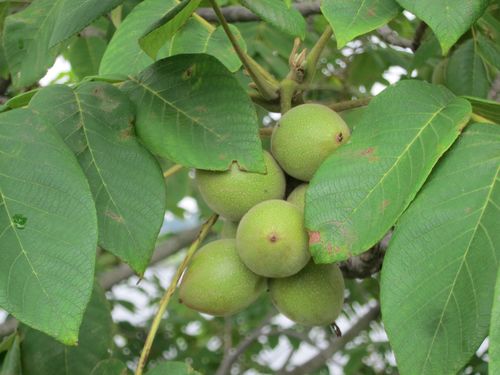
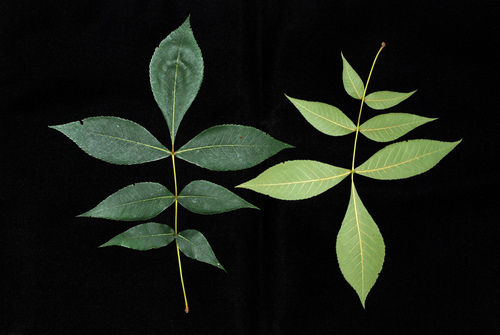
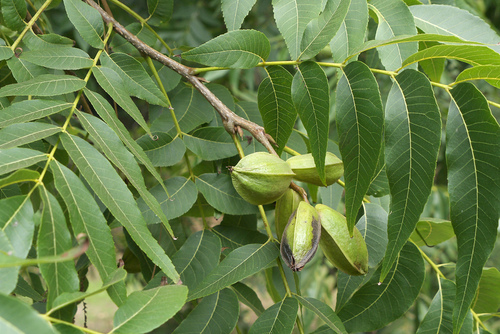
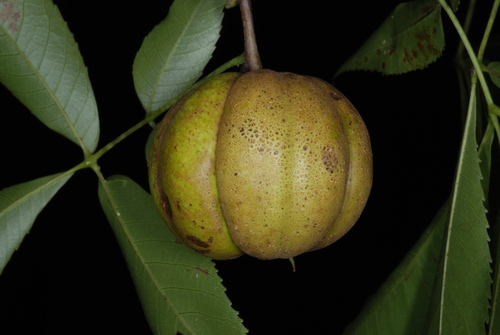
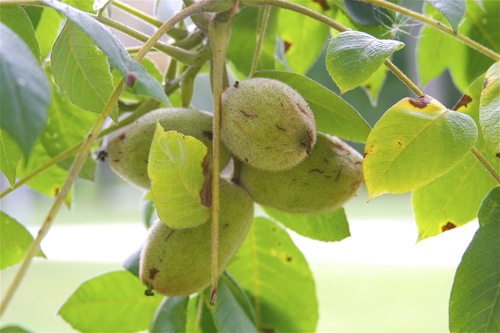
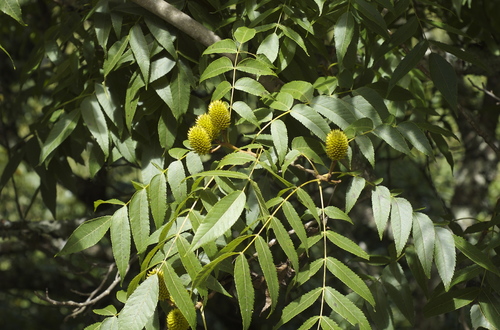
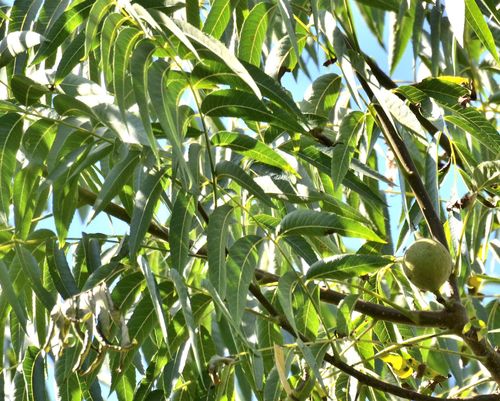
Juglans hindsii is a large tree that reaches 7–23 metres (23–75 ft) tall on average, and may grow over 30 m (100 ft) tall when grown in sufficient shade. This species typically has a single erect trunk, most often without branches along its lower half, and a crown that can be wider than the tree is tall. Trunk diameter at the base can reach 1.5–1.8 m (5–6 ft). The leaves of Juglans hindsii are approximately 0.3 m (1 ft) long, each holding 13–21 leaflets. Individual leaflets are 5–12.5 centimetres (2–5 in) long with dentate margins. Tufts of hair grow in the vein axils on the underside of leaflets, a trait that distinguishes this species from the Southern California walnut. Juglans hindsii is monoecious: its male flowers are yellow-green catkins that grow up to 15 cm (6 in) long, while female flowers grow in groups of 1–3 from young twigs. The species produces nuts up to 4 cm (1+1⁄2 in) across, with smooth, brown, thick shells. Historically, Juglans hindsii was recorded as native to Northern California, ranging from the San Joaquin Valley and Sacramento Valley to the inner northern California Coast Ranges and San Francisco Bay Area. A 2020 IUCN assessment extended its confirmed native range north to Oregon and south to Southern California, across areas with matching suitable habitat. The northernmost known pre-colonial Juglans hindsii grew in Douglas County, Oregon, until it was blown over in November 2017. A ring count of this tree confirmed it predated the arrival of European settlers by roughly 100 years. The Native Plant Society of Oregon has also documented multiple pre-colonial age Juglans hindsii in Oregon's Rogue Valley. This tree grows in riparian woodlands, where it can form single-species stands, or grow mixed with California oak species (Quercus spp.) and Fremont cottonwood (Populus fremontii). Juglans hindsii is commercially important as a rootstock for commercial orchard-grown Juglans regia (English walnut) grown across the world. It is also one of the parent species of the fast-growing Luther Burbank hybrid rootstock commonly called "Paradox" (Juglans hindsii x Juglans regia). The Northern California walnut is cultivated by specialty California native plant nurseries. It is planted as an ornamental tree in traditional and wildlife gardens, as well as in habitat gardens, natural landscaping projects, and climate-compatible drought-tolerant gardens. It is also planted for habitat restoration projects. The nuts of Juglans hindsii are edible. In the lumber and woodworking industries, its wood is commonly known as claro walnut. It is highly figured, with a rich brown color and striking grain patterns, particularly in the crotch areas where large limbs join the trunk. Due to its durability, good working properties, and swirling iridescent figure, it is used in small quantities to make fine furniture and gun stocks, and sold as slabs for large natural-top tables. There is common confusion surrounding claro walnut, because Juglans hindsii is often used as the rootstock for grafted orchard walnut trees. The section of the grafted tree below the graft junction is claro walnut from Juglans hindsii, while the section above the graft is lighter-colored wood from English walnut. Some woodworkers intentionally feature this color change in their finished work.