About Jovellana repens (Hook.fil.) Kraenzl.
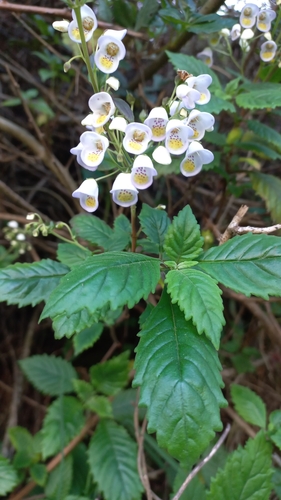
Jovellana repens, formally named Jovellana repens (Hook.fil.) Kraenzl., is a perennial herbaceous plant that grows into a mat reaching 1 to 2 meters in diameter. It produces dark red or green stems 2 to 3 centimeters long. Its leaves attach to hairy petioles that measure 5–12 mm long by 2–2.3 mm wide, and the leaves themselves are 1 to 4 centimeters long. The upper surface of the leaves ranges from dark green to reddish green, while the lower surface is pale green to light red.
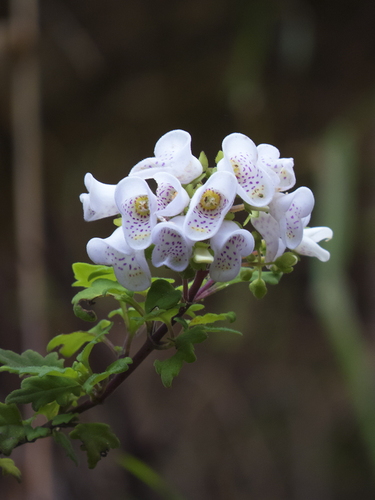
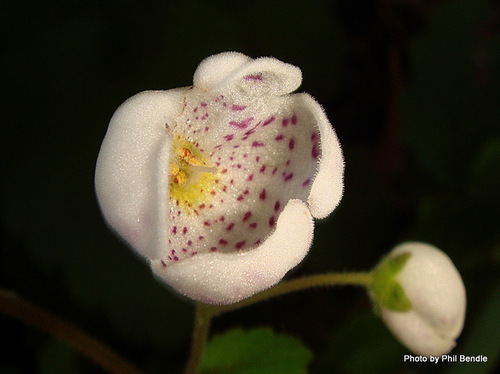
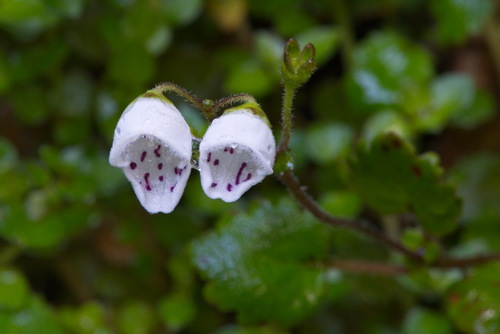
Its inflorescences hold between one and five flowers, most often two to three, and the flowers are partially hidden by the plant’s foliage. The inflorescences have bare pedicels. The flowers are 6 millimeters in diameter, with sepals 1 to 2 millimeters long. They are white with small purple spots on the inner surface, and have two concave lips.
This species fruits from October through February. It produces dark red-brown seeds that are 0.35 to 0.5 millimeters long, and each seed is hidden inside an ovoid (egg-shaped) seed capsule that measures 6 to 7 millimeters. Seeds are dispersed by wind, and may also be dispersed by water.
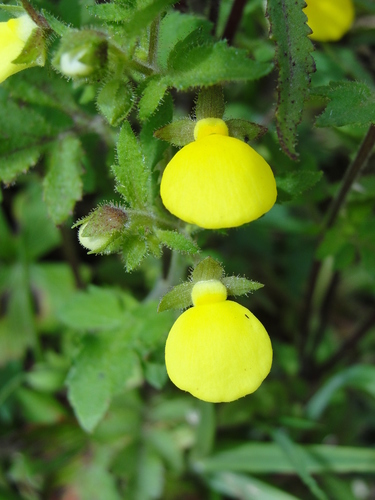
Jovellana repens is very similar to Jovellana sinclairii, but can be told apart by its growth habit: Jovellana repens grows creeping, while Jovellana sinclairii grows as a small shrub. Jovellana repens also has smaller leaves and smaller flowers, and its inflorescences hold fewer flowers, usually two to three per inflorescence. It is also similar to Brachyglottis sciadophila: Jovellana repens creeps, while Brachyglottis sciadophila grows as a lianoid (woody vine) with long, rarely branched stems. When in flower the difference is obvious, as Brachyglottis sciadophila has bright yellow flowers. Jovellana repens can also be confused with Veronica jovellanoides, but Veronica jovellanoides has circular, spatula-shaped leaves, inflorescences holding one to seven non-pouched flowers, and a magenta corolla.
Jovellana repens is native to the North and South Islands of New Zealand, where it occurs south from Mt Pirongia (west) and Te Moehau (east). It grows in shady locations, alongside stream banks, and also on open banks and cliffs in lowland to montane forest.