About Jordanella floridae Goode & Bean, 1879
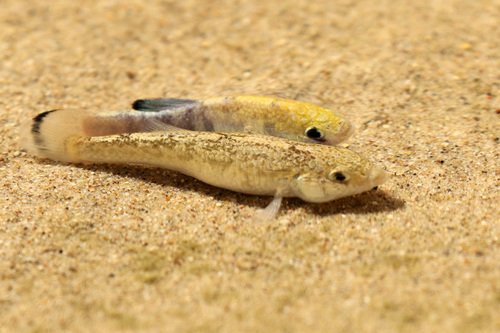
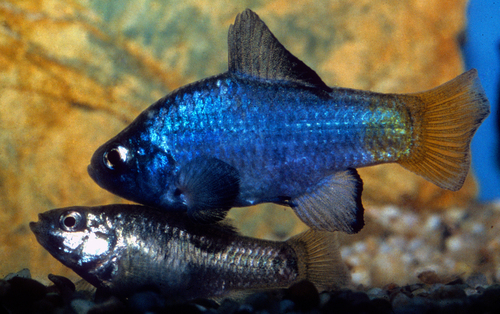
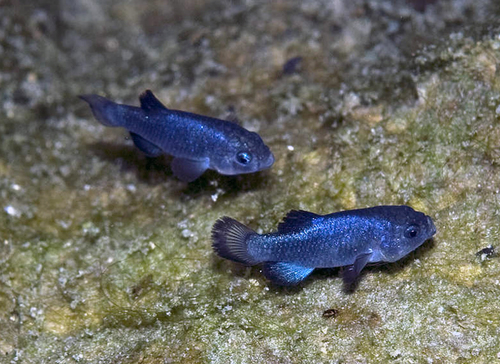
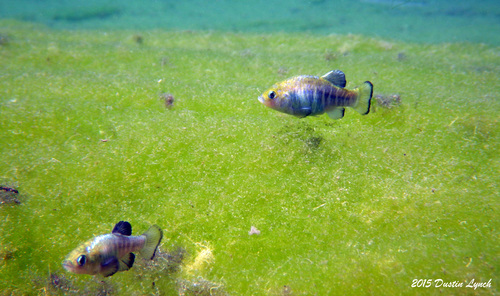
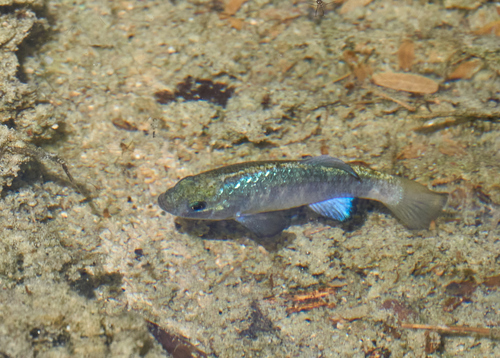
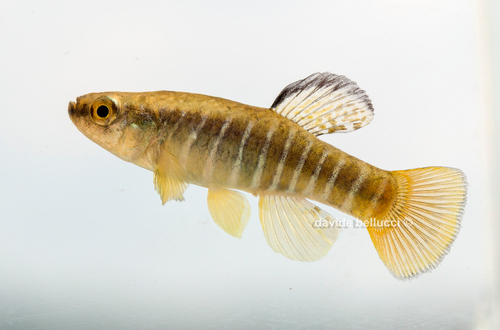
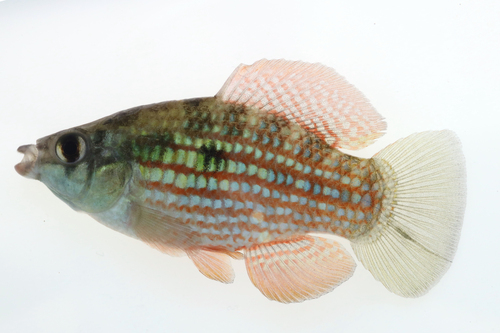
Jordanella floridae, commonly known as the flagfish, are small, robust fish that reach 6 centimetres (2.4 inches) in length. They have a truncated snout that has been compared to that of a bulldog, and rounded fins with the dorsal and anal fins positioned posteriorly, adjoining the caudal fin. Females have an obvious spot on their flanks, plus a clear spot with an opaque white margin near the posterior end of the dorsal fin. Their fins may show a slight reddish color that comes and goes in any individual, though the reason for this change is unknown. A female's body is mainly olive, marked with turquoise scales. The common name flagfish comes from the male's patterning, which resembles the flag of the United States: a dark rectangle on the shoulder is analogous to the blue and white stars in the corner of the US flag, and stripes along the flanks alternate between red and paler greenish stripes (instead of white). Males also have a dark spot at the lower posterior corner of this dark shoulder rectangle. Nondominant males, females, and juveniles share an underlying olive-grey base color and pattern that becomes covered by the brighter, more colorful pattern of dominant males. The flagfish is endemic to Florida, where it is found across the Florida Peninsula south of the St. Johns River and Ochlockonee River drainage basins. Flagfish normally live in shallow, well-vegetated freshwater habitats including backwaters, marshes, canals, and ditches, though they have occasionally been recorded in slightly brackish water. The flagfish is listed in the Guinness Book of World Records as the fish species that lays the fewest eggs: a female will lay 20 eggs over a period of a few days. Their courtship follows a distinct sequence: the female encourages the male to chase her by nipping him, then the pair face each other while the female swims backwards, after which the male performs a backflip. After eggs are laid, the male guards them and attacks fish that stray too close to the clutch, but he may also eat his own eggs or offspring. Some other sources report that this species shows no parental care at all. This is an omnivorous species. It acts as a micropredator feeding on small invertebrates and zooplankton, but will also consume algae and other plant material. Flagfish are often used for natural hair algae control in suitable aquariums, since they are one of the only fish that consume hair algae in impactful volumes.