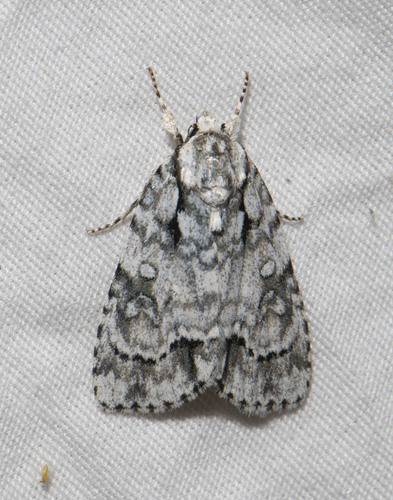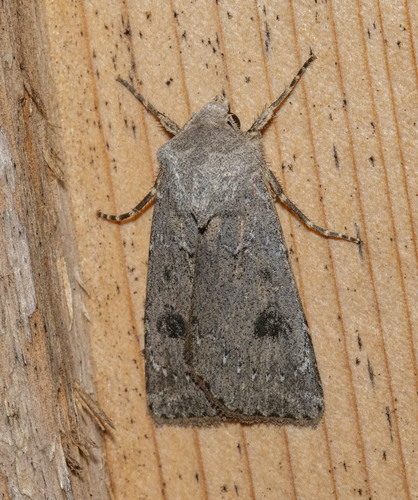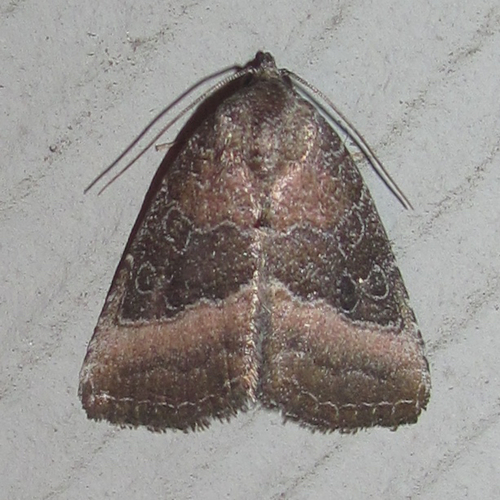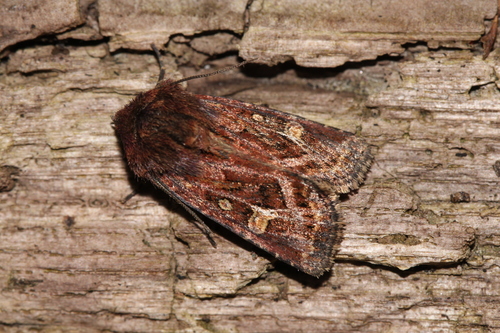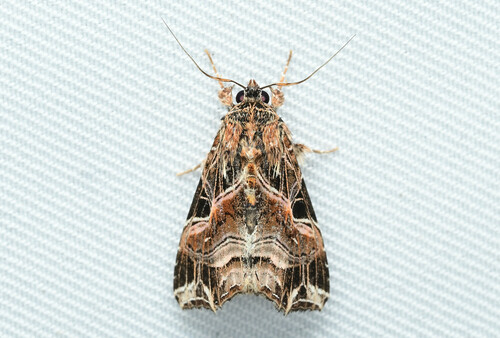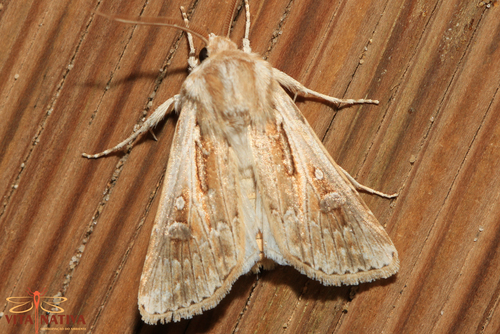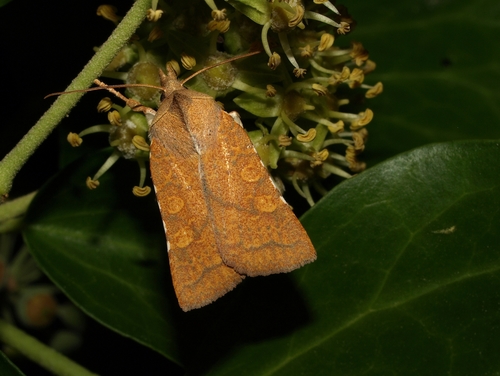
About Jodia croceago (Denis & Schiffermüller), 1775
Under its original name *Xylocampa croceago* (also known as X. aurantiago Don.), Jodia croceago (Denis & Schiffermüller), 1775 has the following technical description and variation. Its forewing is dark yellow, thickly speckled with orange red, and in rare cases has blackish dusting. The costa has 4 white dashes in the median area; its lines are generally olive grey, and sometimes blackish. The inner line is pale, waved, externally edged with darker coloring, and angled outwards in the submedian interval. The outer line sits at 3/4 of the forewing, is curved, and marked by dark vein spots. The upper stigmata are large, pale orange, with yellow annuli; the reniform stigma is 8-shaped and projects outwards below the cell. The median shade is broad, dark grey, running from the inner margin to the outer dark edge of the reniform, and appears to follow this edge; its upper arm from the costa above the orbicular stigma is more or less obscured and often obsolete, only distinct in darker orange, black-speckled specimens. The submarginal line is grey and sinuous; veins toward the termen are often darker. The hindwing is white, with a slight pinkish tinge, and has a cellspot and outer line; the fringe is white. The form fulvago Esp. nec L. has deeper orange suffusion, stronger dark speckling, and a clearly marked upper arm of the median shade. The form corsica Mab., found in Corsica, is a very pale biscuit color, with very pale olive brownish speckling and lines; its stigmata are large and pale, lacking annuli or central markings, and its hindwing is whiter. The larva is yellowish grey, dotted with dark red; the tubercles are white; the dorsal line is pale and inconspicuous; it has a row of brown V-shaped marks on segments 4 through 11; the 11th segment has a slight hump and two broad white spots behind the hump; the head is large, red-brown, and dotted with pale markings. The wingspan of this species is about 35 mm.