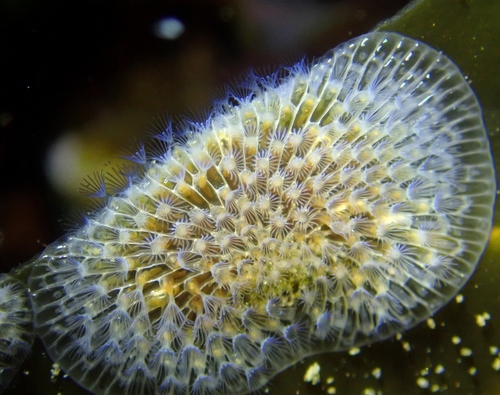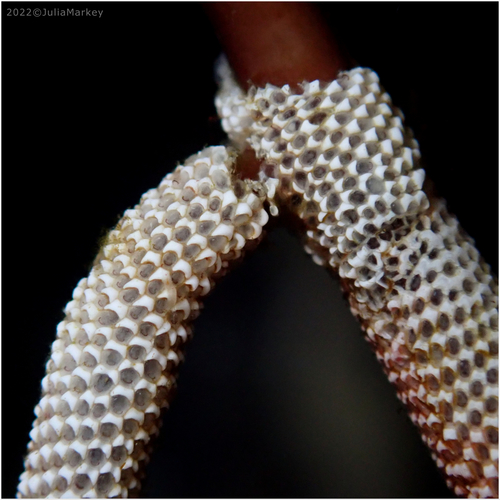
About Jellyella tuberculata (Bosc, 1802)
Morphology: Jellyella closely resemble Membranipora, and like other members of the family Membraniporidae, they have twinned ancestrular zooids. However, Jellyella can be distinguished by intricately branched processes called spinules that project into the zooidal chambers. Jellyella also have a calcitic skeletal ultrastructure made up of transversely arranged, elongate spindles. Ecology: Jellyella is unusual as a pseudoplanktonic bryozoan that encrusts floating objects, both natural and artificial. Jellyella eburnea is common on shells of the squid Spirula, which become detached from the squid's soft body after death, and on the shells of the planktonic gastropod Janthina. Jellyella tuberculata grows on the floating alga Sargassum, and on flat-bladed kelp and other seaweeds around the Cape Peninsula of South Africa. In Cape waters, it is preyed upon by the crazed nudibranch Corambe sp. By contrast, most other bryozoans are benthic, encrusting hard substrates such as kelp or rocks. Jellyella can survive across various ocean environments. Its growth efficiency increases as food concentration increases <Swezey>