About Janthina janthina (Linnaeus, 1758)
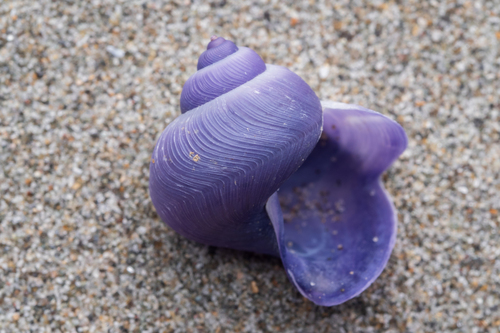
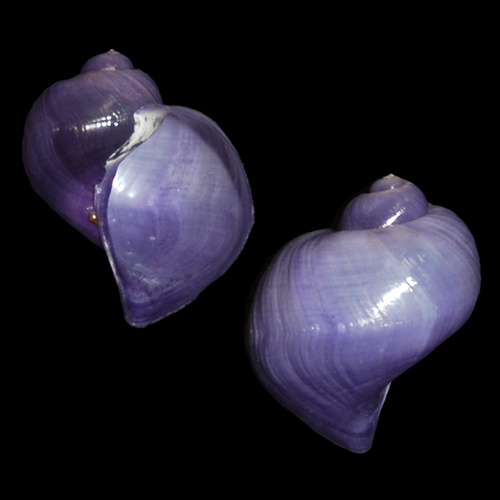
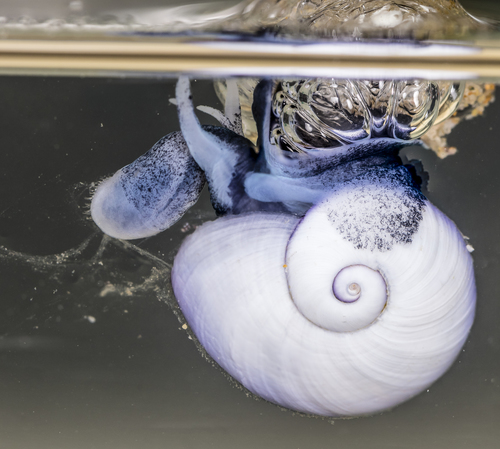
Janthina janthina (Linnaeus, 1758) is a member of the family Janthinidae, a group of snails that trap air bubbles to stay at the ocean surface, where they act as predators of hydrozoa. The air bubbles they use are stabilized by secreted amphiphilic mucins, which evolved from epitoniid egg masses. This passive flotation method is an especially resource-efficient form of animal locomotion. Apart from the bubble raft that supports flotation, only the veliger larval stage of this species has an operculum, and adult individuals have no operculum. The snail’s shell is paper-thin, which allows it to float upside down at the ocean surface. Because of this constant upside-down positioning in the water column, the snail’s shell shows reverse countershading: the spire of the shell has a light purple shade, and the ventral side has a darker purple. Overall the shell is violet with a paler upper surface, almost smooth, and has a slightly depressed-globose shape. It is thin and delicate. The shell of this species reaches a maximum height of 38 mm and a maximum width of 40 mm. The snail has a large head on a very flexible neck, and its small eyes are positioned at the base of its tentacles. J. janthina is protandrous: it starts life as a male and later changes into a female. Females hold their eggs until the eggs develop into the larval form. This species is found worldwide in warm tropical and temperate seas, floating at the surface. It specifically occurs in the tropical and subtropical Atlantic, Indian, and Pacific oceans. Individuals are often found in large groups, and strong winds sometimes blow them ashore, leaving them stranded on beaches. Because of their relatively large size, these snails are a unique component of the neuston, the community of organisms that live on or near the ocean surface. Their veliger larvae are free-swimming, but adult snails do not swim, and can only build their bubble rafts at the surface where air bubbles are available. These pelagic snails drift on the ocean surface, and feed on pelagic hydrozoa, especially Velella velella (the by-the-wind sailor) and Physalia physalis (the Portuguese man o' war).