About Janthina globosa Swainson, 1822
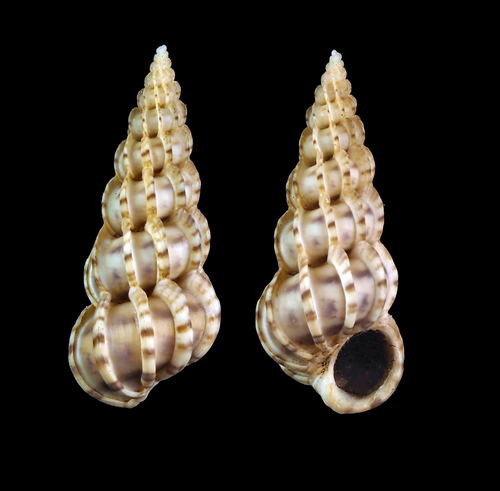
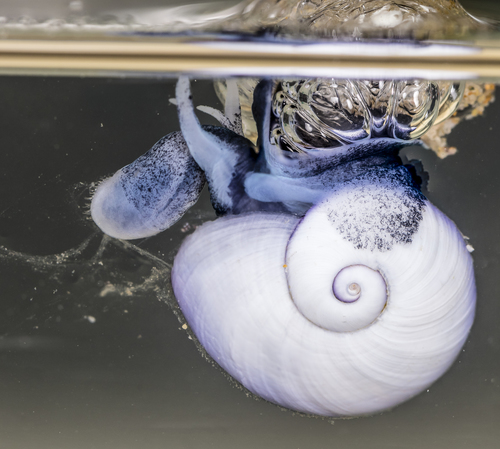
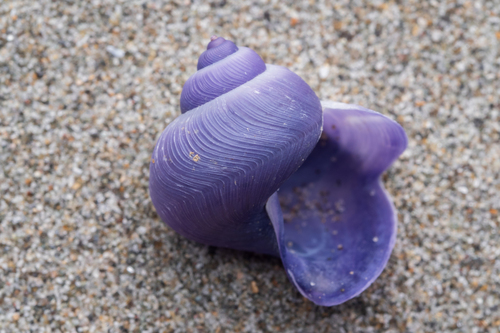
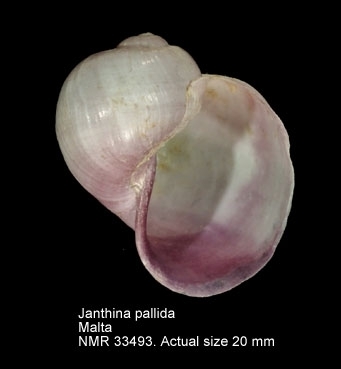
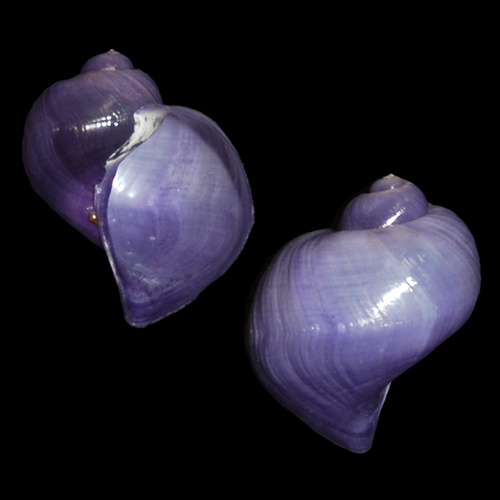
Anatomy and morphology. Janthina globosa, commonly called the violet snail, is a neustonic organism defined by its thin, fragile purple shell and large size. The maximum recorded shell length for this species is 38.5 mm. Females typically grow larger than males, which makes it simple to tell the two sexes apart. J. globosa has a glossy shell with four evenly spaced, symmetrical spirals. The snail’s soft body lives inside this hard outer shell, and features forked cephalic tentacles on its ventral side. These tentacles are used for functions including locomotion and collecting sensory input. The snail’s distinctive purple color acts both as camouflage in its environment and as an adaptation that improves its ability to obtain food, making it a more effective predator. Like the epipodium of many other Janthina species, J. globosa’s epipodium is thought to help it maintain equilibrium in water (Wilson and Wilson, 1956, 301).
Distribution and habitat. Alongside J. globosa, four other species of the genus Janthina are found in the Mediterranean Sea. All members of the genus, including J. globosa, generally occur between latitudes 50°N and 40°S, though individuals can be found outside this range when conditions allow. Strandings of J. globosa and other species in its genus are caused by wave and current movement (F. Betti et al 2017). The species occurs from a minimum recorded depth of 0 m to a maximum recorded depth of 13 metres (43 ft).
Reproduction. Janthina globosa is hermaphroditic and reproduces sexually. It does not retain the sex it is born with: it begins life as a male, then undergoes protandry, changing into a female to reproduce. The species lays pale pink eggs on the underside of its float, where the eggs remain attached until they hatch. (Wilson and Wilson, 1956, 302)