About Janolus flavoanulatus Pola & Gosliner, 2019
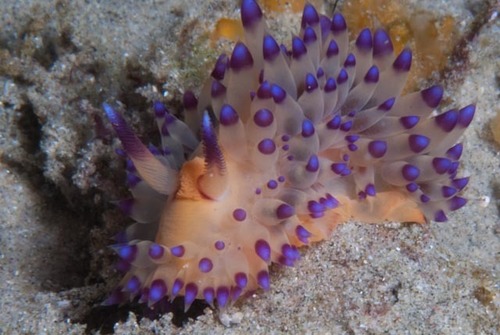
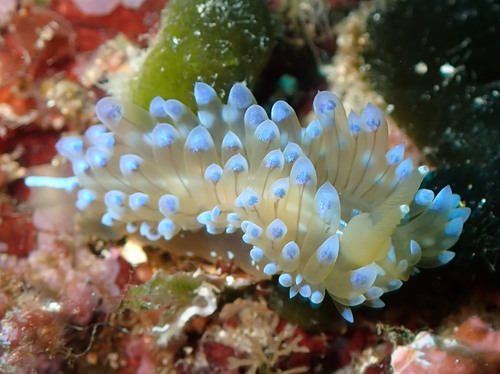
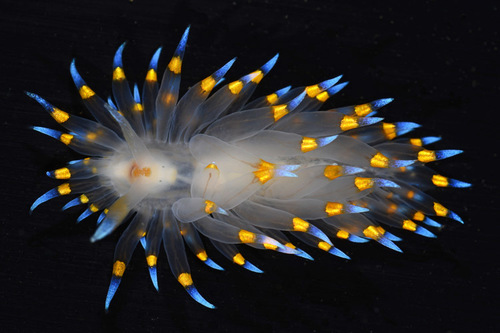
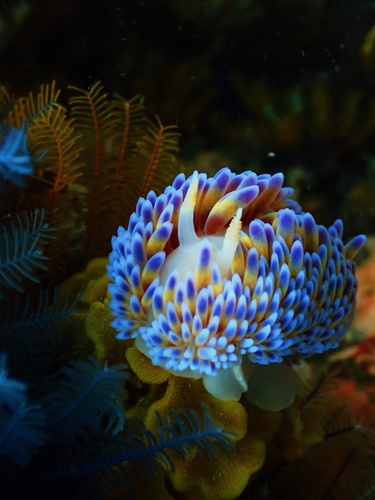
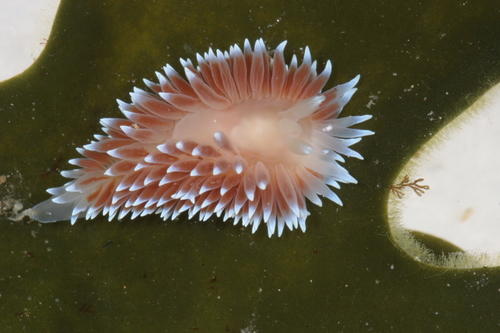
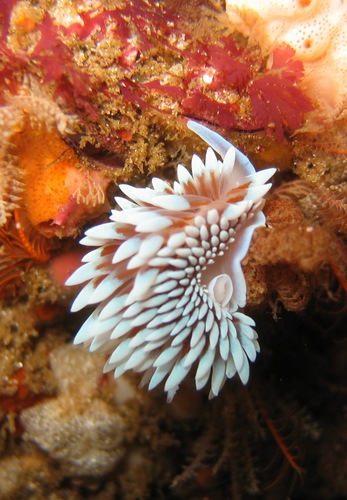
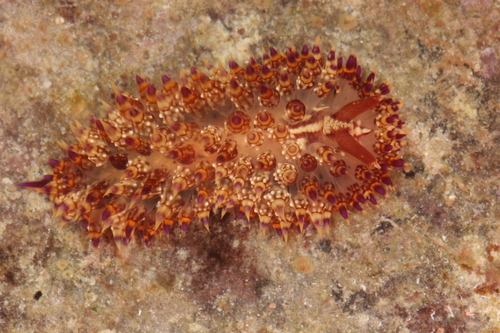
Janolus flavoanulatus Pola & Gosliner, 2019 is a species of shell-less nudibranch mollusk. Individuals have elongated bodies that reach roughly 50 millimeters in length, and are covered in numerous round, pointed papillae with distinctive forms and colors. Externally, these nudibranchs are bilaterally symmetric, with separate female and male reproductive openings on the sides of their soft bodies. They lack the mantle cavity that typically covers the visceral mass, but have a simple gut and a radula. Right behind the rhinophores sit two eyes; a pair of finger-like oral tentacles extends out from either side of the head, and these structures are critical for sensing the surrounding environment. This species can be identified by its unique coloration: it has translucent white bodies and cerata, with violet purple cerata tips that have a bright blue apex. Below the purple subapical ring on each ceras, there are additional yellow and brown rings. Its rhinophores are brownish-purple with white tips, and its caruncle is pale. A faint blue line lines the edge of its foot. This species has been recorded in the Indian Ocean and Western Pacific Ocean, specifically from the Red Sea, the Philippines, Papua New Guinea, Japan, the Solomon Islands, Indonesia, Vanuatu, and Australia. While its global conservation status has not been formally assigned, observational data suggests the species is becoming scarcer due to broader biodiversity decline. Members of the genus Janolus live in areas with fluctuating temperatures, at shallow subtidal water depths, and can also be found much deeper below the ocean surface. Individuals that live closer to the surface occupy the photic zone, which provides a stable, well-lit environment. Habitat loss and pollution are major threats to this marine species. Like most nudibranchs, Janolus flavoanulatus is a hermaphrodite, with both male and female reproductive organs. This is a convenient reproductive adaptation for its solitary lifestyle, as any mature individual can mate with another individual it encounters. Dispersed eggs develop into free-swimming larvae that eventually sink toward the ocean surface and mature into adult nudibranchs. Eggs are held in capsules, and typically hatch in approximately one week if temperatures are favorable. Before metamorphosing into adults, larvae drift with water currents and feed on plankton, and they shed their larval shells during this transformation.