About Jadera haematoloma (Herrich-Schäffer, 1847)
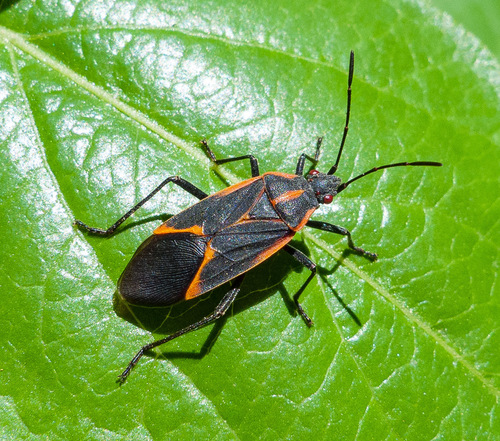
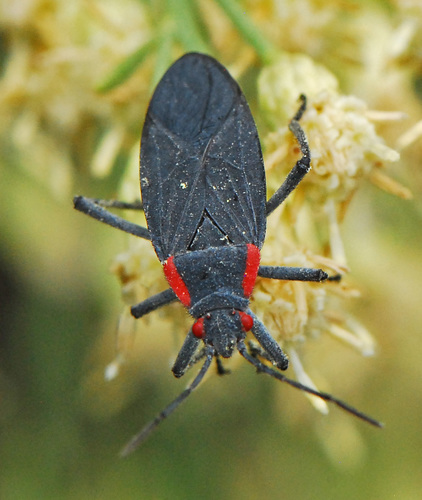
This species, Jadera haematoloma, is typically 9.5–13.5 millimetres (0.37–0.53 in) long and 3–4 millimetres (0.12–0.16 in) wide. The short-winged brachyptera form is usually smaller, at 7–8 millimetres (0.28–0.31 in) long. Most of the body is blackish, and can sometimes be bluish grey or purplish; individuals are bright red immediately after molting. Exceptions to this base color are red eyes, the "shoulders" (lateral margins of the pronotum), the costal margins, and the dorsal part of the abdomen. Nymphs are mostly red, with a black pronotum and black wingpads. All appendages are blackish. For most of the twentieth century, little was known about the range of J. haematoloma. Reports confirm breeding populations exist across many U.S. states: Florida, Kansas, Colorado, Texas, Arizona, California, Alabama, Illinois, North Carolina, Missouri, Iowa, Georgia, South Carolina, Tennessee, Virginia, Pennsylvania, Maryland, and Royal Oak, Michigan. Isolated specimens have also been recorded as far north as Minnesota. A 1987 published study mapped J. haematoloma's distribution and revealed that the bug's occurrence records closely match the ranges of soapberry plants, its native hosts. Outside the United States, J. haematoloma is found south from the U.S. through Central America and the West Indies, all the way to Colombia and Venezuela. While the species is native to the New World, the discovery of J. haematoloma populations in Taiwan in 2012 marked the first time this species, and its entire genus, was found in Asia. It is extremely common to observe pairs of these bugs joined tail to tail. In populations of J. haematoloma, males outnumber females by roughly a two-to-one ratio. As an evolutionary adaptation to this ratio, males extend copulation to around two days, which prevents sperm competition from other males.