About Jacobaea maritima (L.) Pelser & Meijden
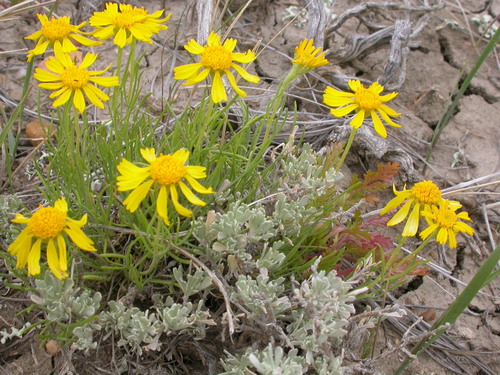
Jacobaea maritima (L.) Pelser & Meijden, commonly called Silver Ragwort, is an evergreen subshrub with very white woolly foliage, that tolerates heat and drought. It grows 0.5–1 m (1.6–3.3 ft) tall. Its stems are stiff and woody at the base, densely branched, and covered in long, matted grey-white to white hairs. Its leaves are pinnate or pinnatifid, 5–15 centimetres (2.0–5.9 in) long and 3–7 centimetres (1.2–2.8 in) broad, stiff, with oblong, obtuse segments. Like the stems, leaves are covered in long, thinly to thickly matted grey-white to white hairs. Lower leaves are petiolate and more deeply lobed, while upper leaves are sessile and less lobed. The dense woolly tomentum is thickest on the underside of the leaves, and may wear off the upper surface over time, leaving the top surface glabrous with age. Its flowers are yellow and daisy-like, arranged in dense capitula 12–15 millimetres (0.47–0.59 in) in diameter. Each capitulum holds central disc florets surrounded by a ring of 10–13 ray florets, and is enclosed in a common whorl of bracts at its base. Its seeds are cylindrical achenes.
Jacobaea maritima is native to the western and central Mediterranean region, including northwest Africa (Morocco, northern Algeria, Tunisia), southern Europe (Spain, Gibraltar, southern France including Corsica, Italy including Sardinia and Sicily, Malta, Slovenia, Croatia, Bosnia and Herzegovina, Kosovo, Albania, Montenegro, Serbia, Macedonia, and Greece), and the far west of Asia (Turkey). It grows primarily on cliffs and rocky coastal sites, and more rarely inland. It is also naturalized further north in Europe, reaching as far north as Great Britain and Ireland where it occurs mainly in mild coastal areas, and is found locally in North America.
Like many other plants with dense tomentum, the hair-like tomentum covering the stems and leaves of this species is collected by some bee species (for example Anthidium manicatum and Anthidium oblongatum in the family Megachilidae) for use in nest-building. Hybrids of Jacobaea maritima are known to form with Jacobaea erucifolia and Jacobaea vulgaris. Hybrids with Jacobaea vulgaris are fertile, and produce a wide range of intermediate progeny.
Jacobaea maritima is widely used in horticulture, valued for its silvery foliage. It is winter-hardy in USDA Zones 8 to 10, tolerating winter temperatures down to -12° to -15 °C. It tolerates light shade but prefers full sun. In colder regions, it is grown as an annual. Many cultivars have been selected for especially dense silvery tomentum, including 'Cirrus', 'New Look', 'Ramparts', 'Silverdust', 'Silver Filigree', and 'White Diamond'. In North America, it is recommended for its fire resistance, resistance to deer browsing, and salt tolerance. The cultivar 'Silver Dust' has received the Royal Horticultural Society's Award of Garden Merit. There is widespread confusion between Jacobaea maritima and Centaurea cineraria in the horticultural trade; this has led to uncertainty over which cultivars belong to which species, and also caused widespread confusion in online photographs of these two species.