About Jacksonia scoparia R.Br.
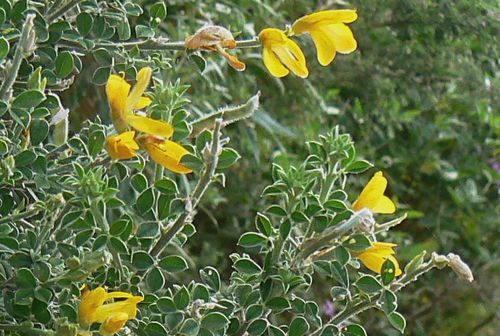
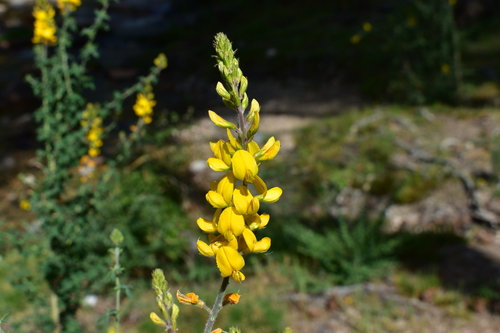
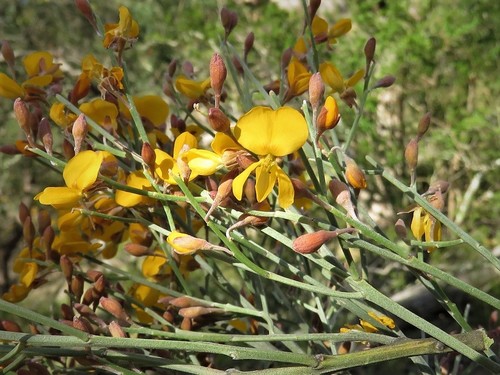
Jacksonia scoparia R.Br. is a shrub or small tree that usually grows 3–5 metres (9.8–16.4 feet) high, and may sometimes reach up to 12 metres (39 feet) tall. This species has erect or pendulous branches and branchlets that are strongly angled or winged. Its bark is grey, rough, and marked with furrows. Its leaves are reduced to dark brown, egg-shaped scales. Flowers are scattered along the branches, each growing from a 2.3–3.9 millimetre (0.091–0.154 inch) long pedicel. Egg-shaped bracteoles 0.4–0.7 millimetres (0.016–0.028 inch) long form on the pedicels, though these bracteoles are sometimes lost. The floral tube is 0.7–0.9 millimetres (0.028–0.035 inch) long. The sepals are membranous and 3.8–4.1 millimetres (0.15–0.16 inch) long, with lobes 3.0–4.1 millimetres (0.12–0.16 inch) long. Petals are yellowish-orange with red markings: the standard petal is 5.2–7.2 millimetres (0.20–0.28 inch) long, the wing petals are approximately 4.5–6.3 millimetres (0.18–0.25 inch) long, and the keel petal is 4.1–5.7 millimetres (0.16–0.22 inch) long. The stamens have yellowish-green filaments that are 3.7–6.3 millimetres (0.15–0.25 inch) long. Flowering occurs year-round, with a peak from spring to early summer. The fruit is a membranous, oval pod 3.2–8 millimetres (0.13–0.31 inch) long. Jacksonia scoparia is widely distributed across south-east Queensland and eastern New South Wales north of Bega. It grows in woodland on hillsides and ridges, most commonly on low-nutrient soils. The species’ tendency to flower profusely makes it an attractive plant for garden cultivation. It was first introduced into cultivation in England in 1803, and it can grow in positions with full sun or partial shade. During droughts, this dogwood has provided useful fodder that cattle relish. Propagation is relatively easy from seed after pre-treatment with boiling water, matching propagation methods for other pea family members. Cuttings also root reasonably readily.