About Jacamerops aureus (P.L.S.Müller, 1776)
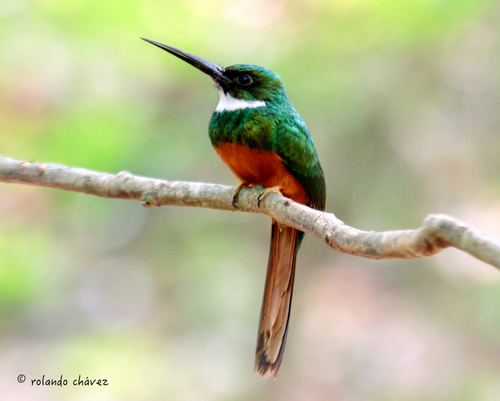
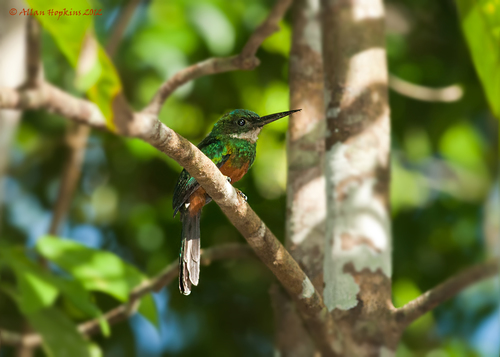
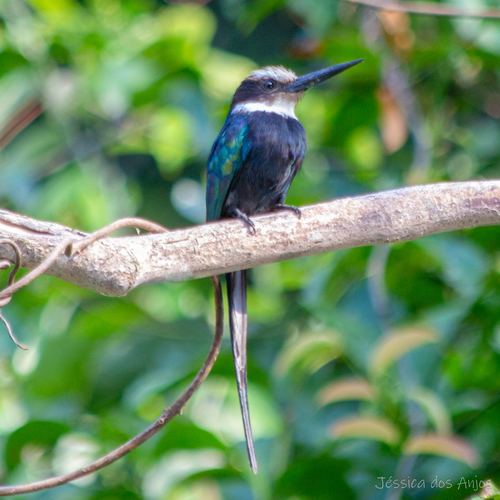
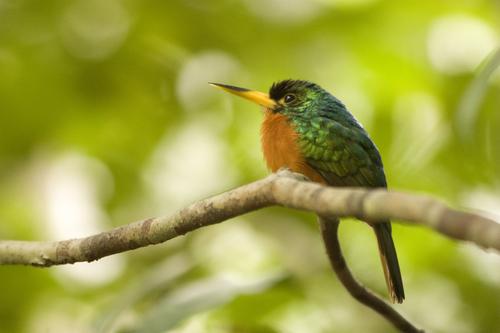
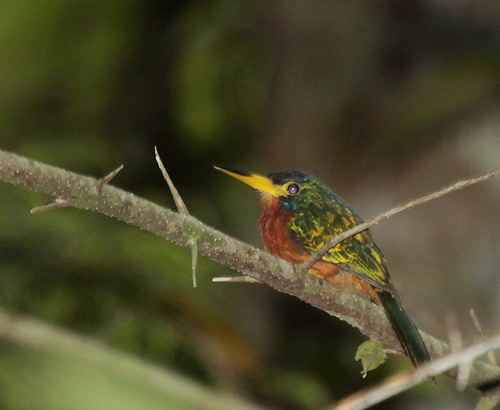
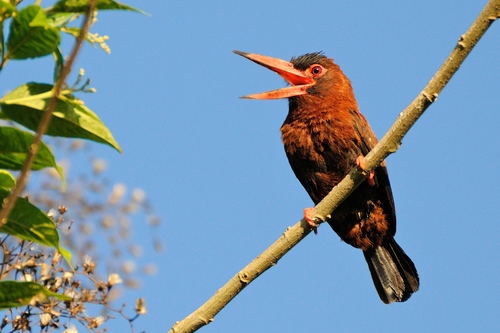
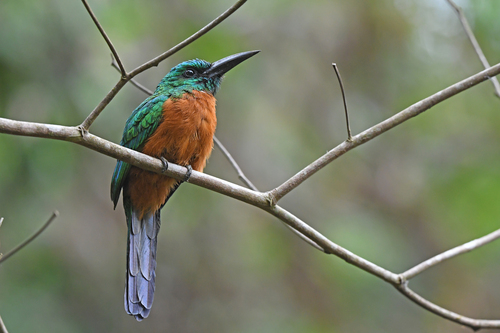
Jacamerops aureus, commonly called the great jacamar, measures 25 to 30 cm (9.8 to 11.8 in) in length and weighs between 57 and 70 g (2.0 and 2.5 oz). As its name suggests, it is the largest species in the jacamar family, and far bulkier than any other jacamar species. For adult males, the chin, cheeks, and upper body are bright metallic green with gold overtones; the chin, forehead, and tail carry a blueish tinge, and the back has purple copper tones. The lower throat is white, and the rest of the underbody is deep rufous. The primary flight feathers are black, the tail is blue-black, the bill is black below, and the legs are dark horn-colored. Females resemble males, but lack the white patch on the throat. Like all members of the order Piciformes, jacamars have zygodactyl feet, with two toes pointing forward and two facing backward. This toe arrangement helps jacamars grasp branches while hunting in trees. Researcher J. Haffer concluded that jacamars underwent a relatively recent Pleistocene radiation of the family, because 13 of the 17 recognized species in the Galbulidae (jacamar) family belong to superspecies complexes. Jacamars are thought to have originated in the Amazon region, where they are most common, before spreading to other parts of Central and South America. Unique anatomical traits shared by the entire jacamar family include a long appendix, no gall bladder, a bare preen gland, and a long, thin tongue. The natural habitat of Jacamerops aureus is undisturbed tropical forest up to 500 m (1,640 ft) in altitude. It occupies the middle levels of the canopy and the shaded interior edges of rainforest, most often near stream banks. It can be hard to spot, because it is known to stay still in a single spot for long periods of time. Breeding occurs from March to May or June. The nest is a chamber built inside an arboreal termite nest, located 3 to 15 m (10 to 49 ft) above the ground. The great jacamar bores its own hole into these elevated termitaria to create the nesting chamber. Incubation for Jacamerops aureus eggs lasts approximately 20 to 23 days. Chicks leave the nest around 21 to 26 days after hatching; when they emerge, they are fully covered in white down. Females lay one to four round, glossy, white eggs. Both the male and female take turns incubating eggs and caring for hatchlings. During the day, each parent takes incubation shifts of one to three hours at a time. At night, the female incubates alone, while the male remains near the nest to defend it. Jacamars rarely leave eggs unattended. This species feeds on insects caught in flight, and spiders collected from vegetation. It waits perched in the canopy, then pursues prey, beats it against a branch to subdue it, and then consumes it. Some jacamars will also eat small vertebrates such as lizards.