About Jacamaralcyon tridactyla (Vieillot, 1817)
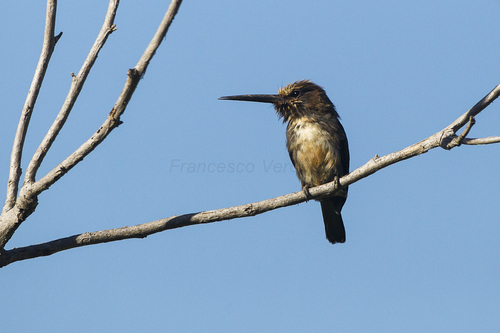
Like all members of its family, the three-toed jacamar (Jacamaralcyon tridactyla) has short legs and short wings. It perches upright, holds its tail downward, and keeps its long, sharply-pointed beak tilted upward. This is a medium-sized bird, measuring 18 cm (7.1 in) long and weighing between 17.4 and 19.3 g (0.61 and 0.68 oz); females are heavier than males on average. Males and females have similar plumage: the upperparts are slaty black with a bronzy-green gloss, and the underparts are somewhat paler. The belly and the center of the breast are white. Adult birds have a brownish-gray cap and a black throat. The cap, chin, and sides of the head are finely marked with pale fulvous streaks. Its bill is black, and its feet are slaty gray. Unlike other members of its family, the three-toed jacamar has three toes instead of four. Its small zygodactyl feet lack a hind toe, and the two front toes are fused together at the base. The three-toed jacamar is endemic to southeastern Brazil, where it lives in drier parts of the Atlantic Forest. It is now restricted to the states of Rio de Janeiro (primarily in the Paraíba do Sul valley) and eastern Minas Gerais, though it previously had populations in Espírito Santo, São Paulo, and Paraná. While it is generally found in intact forest, it can survive in more degraded areas such as plantations, as long as a native understory layer remains. There is some evidence that it associates with streams, because it needs earthen banks to nest; it also uses banks created by road cuttings. This species is largely sedentary, though young birds disperse after fledging, and adult birds sometimes move short distances. Like all jacamars, the three-toed jacamar is an insectivore. It feeds preferentially on small, cryptically colored moths and butterflies, and Hymenoptera, but will also eat flies, dragonflies, beetles, true bugs, and termites. It hunts from an open perch in the forest understory or along the forest edge, flying out to catch prey. It often beats captured prey against a branch to stun the insect, remove stingers, venom, and wings.