About Jabiru mycteria (Lichtenstein, 1819)
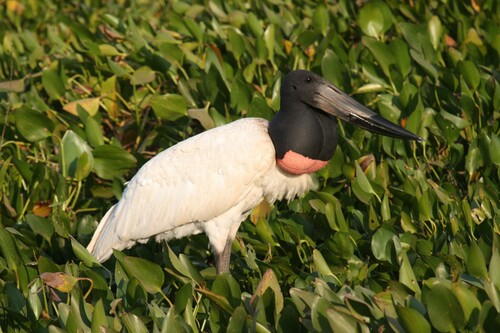
Jabiru mycteria, the jabiru, is the tallest flying bird native to South and Central America. Adults often reach nearly the same standing height as the much heavier, flightless greater rhea. Excluding great albatrosses that occasionally appear off the coast of southern South America, the jabiru has the second largest wingspan on the South American continent, after the Andean condor. Adult jabirus measure 120–140 cm (47–55 in) in total length, with a wingspan of 2.3–2.8 m (7.5–9.2 ft), and a body weight ranging from 4.3–9 kg (9.5–19.8 lb). This species shows very high sexual dimorphism, possibly the most extreme of any stork: males are about 25% larger than females, with an average male weight of 6.89 kg (15.2 lb) and an average female weight of 5.22 kg (11.5 lb). Large males can reach a standing height of up to 1.53 m (5.0 ft). The jabiru’s black, broad beak measures 25–35 cm (9.8–13.8 in), is slightly upturned, and ends in a sharp point. Other recorded standard body measurements include a tail length of 20–25 cm (7.9–9.8 in), a tarsus length of 28.5–39 cm (11.2–15.4 in), and a wing chord length of 58.5–73 cm (23.0–28.7 in). The jabiru’s plumage is mostly white, while its head and upper neck are featherless and black, with a stretchable, featherless red patch at the base of the neck. The sexes have similar overall appearance, with only size differing noticeably when individuals of both sexes are seen together. Though jabirus can look ungainly when on the ground, they are powerful and graceful fliers. Jabirus live in large groups near rivers and ponds, and consume large quantities of frogs, fish, snakes, snails, insects, and other invertebrates. They will also eat fresh carrion and dead fish, such as those that die during dry spells, which helps maintain water quality in isolated bodies of water. Jabiru feed in flocks, and typically forage by wading in shallow water. They detect prey primarily through tactile sensation rather than vision. To feed, jabiru hold their open bill at a 45-degree angle to the water; when prey contacts the bill, the stork closes it, pulls it out of the water, and throws its head back to swallow. Most prey fish caught are 8 to 20 cm (3.1 to 7.9 in) long, but jabiru can catch larger prey, including fish weighing up to at least 500 g (1.1 lb) and eels up to 80 cm (31 in) long. The jabiru is an opportunistic feeder. During one recorded event, when house mice had a population boom in an agricultural area, several hundred jabirus were observed feeding on the rodents in each field—an unusual sight, as jabiru are rarely found in large numbers anywhere. On rare occasions, jabirus have been observed attempting to steal food via kleptoparasitism from the two smaller stork species they coexist with: the wood stork and the maguari stork.