About Izatha huttoni (Butler, 1880)
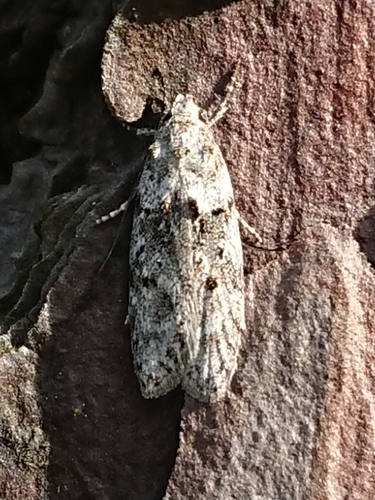
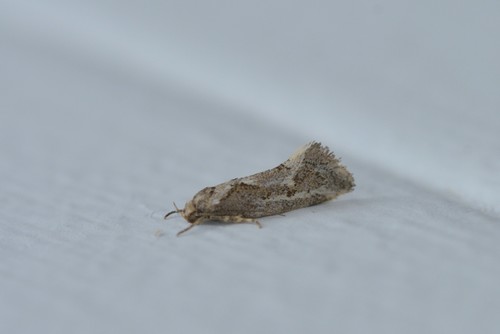
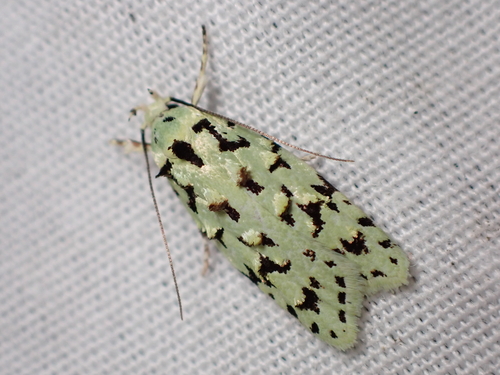
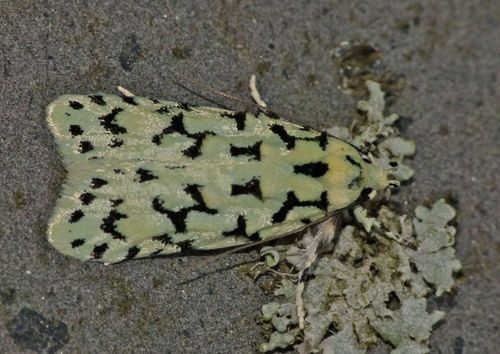
Butler originally described this species as follows: It is allied to O. picarclla. Primaries are greyish-white on the upper side. A short, forked black line runs along the base of the costal margin, with a Y-shaped black marking at the base of the median vein, and an oblong spot beyond this marking. Above the oblong spot, a zigzag line extends to the costal margin. An irregularly zigzag black line runs from the centre of the costal margin to the first median branch. A question-mark-shaped black marking sits on the disc, and a series of black spots rings the wing margin, running from the costa just behind the middle to the inner margin near the external angle. Secondaries are shining grey, with darker, nearly joined marginal spots. The apical half of the fringe is dirty white, crossed by a grey line. The body is white. The underside of the wings is shining brown, with whitish margins and white fringes. The underside of the body is white, with black lateral patches on the venter. The legs are white on the outside, with black-banded tarsi; the anterior pair are black on the inside, with white joints. Wingspan is 1 inch 1 line. I. huttoni has long been confused with I. peroneanella. Differences between these two species are variable and subtle. The most obvious visual feature to distinguish I. huttoni is the M-shaped mark on the forewing disc. This mark is complete in I. huttoni, while in I. peroneanella it is usually broken after the first stroke. In general, although both species have variable colouration, I. huttoni tends to be a paler green, and I. peroneanella is usually a brighter lime green. This species is polymorphic, occurring in green and white colour shades. If this moth becomes wet, its green colour can turn yellowish. A larval description has not yet been positively linked to this species. This species is endemic to New Zealand. It is found in the south of the North Island only around the Wellington region, is widespread across the South Island, and is the only Izatha species found on Stewart Island. I. huttoni is more common in Wellington than the similar species I. peroneanella. Larvae of I. huttoni have been recorded feeding on dead branches of Aristotelia serrata, and the species has been reared from Coprosma robusta.