About Izatha attactella Walker, 1864
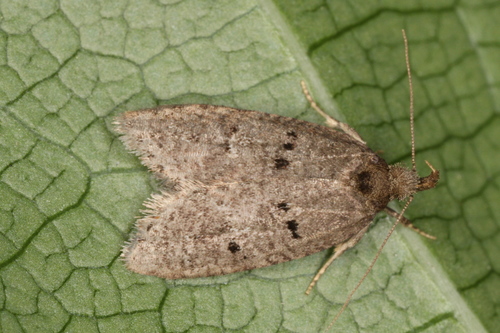
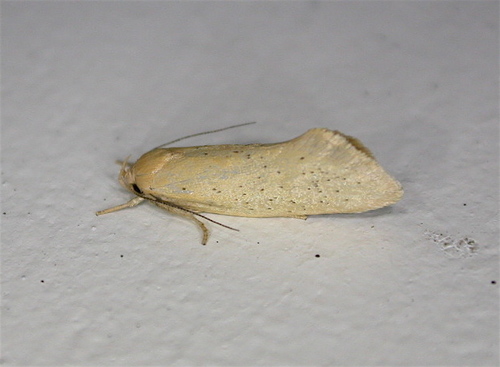
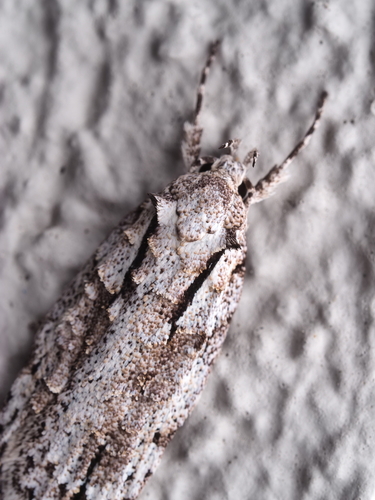
Izatha attactella was first described by Francis Walker in 1864, with additional larval description provided by George Hudson. When fully grown, larvae of this species are approximately 7⁄8 of an inch long. They have dark brown, shiny heads and completely white bodies. The pupa is pale ochreous, with a brown tinge on its head and lower portion. It is contained inside an oval cocoon constructed from silk and bits of chewed bark. Walker's description of adult male I. attactella notes the species is hoary, covered in fine minute black speckles, and is cinereous and shining on the underside. The third joint of the palpi has three blackish bands. The forewings bear a black, slightly dislocated line that is darkest and most sharply defined toward the base, and does not reach the wing tip. Elongated blackish marginal points run along the marginal area and the outer portion of the costa. The forewing disc contains several small, transverse, irregular brown dots. Hindwings are pale cinereous and shining. A variant of the species has forewings clouded with brown. Walker recorded body length as 6–8 lines, and wing length as 16–20 lines. Measured wingspans are 24.5–38 mm for males and 22–36 mm for females. I. attactella is visually similar to the related species I. voluptuosa, but can be distinguished by its narrower forewing, paler hind wing, more prominent scale tufts, and longer dark basal streak. The flight periods of the two species also differ: I. attactella flies earlier in the season, from September to December, while I. voluptuosa is active from November to February. This species is endemic to New Zealand, where it is widespread across both the North and South Islands. On the South Island, its range extends only as far south as mid Canterbury. Recorded locations for I. attactella include Northland, Auckland, Coromandel, Waikato, Bay of Plenty, Taranaki, Taupo, Hawkes Bay, Rangitikei, Wellington, Marlborough Sounds, Nelson, Buller, Marlborough, and mid Canterbury. Larvae of I. attactella feed under the bark of dead trees, consuming the soft inner surface of the bark. Documented host trees and substrates include dead bark of Elaeocarpus dentatus, Aristotelia serrata, Nothofagus, Myoporum laetum, and Rhopalostylis sapida, as well as dead wood from Castanea, Litsea calicaris, Olearia paniculata, Pinus patula, Pinus radiata, and Sophora species. In Auckland, larvae have also been recorded feeding on dead, rotten wood lying on the ground. Pupation occurs under bark inside the oval silk-and-chewed-bark cocoon. Adults are generally on wing from September to December. In the South Island, occasional specimens may still be found in December and January. When reared in captivity in the North Island, adult moths emerge starting in July. This species does not readily come to light traps in large numbers.