About Ixora coccinea Comm. ex Lam.
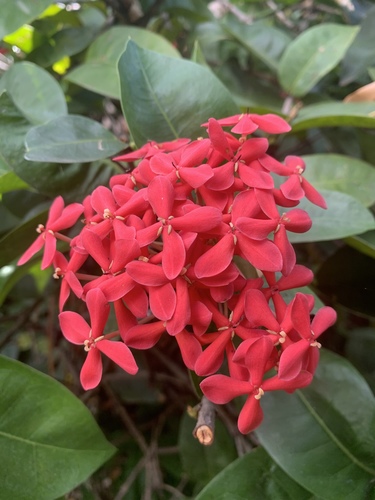
Ixora coccinea Comm. ex Lam. is a dense, multi-branched evergreen shrub. It most commonly reaches 4–6 ft (1.2–1.8 m) in height, but can grow as tall as 12 ft (3.7 m). It grows in a rounded shape, and its spread can be greater than its height. Its leaves are glossy, leathery, oblong, and around 4 inches (10 cm) long, with smooth entire margins; leaves grow in opposite pairs or arranged in whorls along the stems. Small, tubular, scarlet flowers grow in dense, rounded clusters 2–5 in (5.1–12.7 cm) across, and are produced almost year-round. The genus Ixora contains around 500 species, but only a small number are commonly cultivated, and the common name "Ixora" usually refers specifically to I. coccinea. In warm climates, I. coccinea is used for hedges and screens, foundation plantings, mass plantings in flowering beds, and grown as a specimen shrub or small tree. In cooler climates, it is grown in greenhouses or as a potted houseplant that requires bright light. It also grows well in containers, and makes a striking ornamental plant for patios or poolside areas. This tight, compact, heavily branched shrub tolerates hard pruning, which makes it ideal for formal hedges, though it looks its best when it is not sheared. There are many named cultivars of I. coccinea that vary in flower color, including yellow, pink, and orange, as well as in mature plant size. Several popular cultivars are dwarf varieties that usually stay under 3 ft (0.91 m) tall. Nora Grant is a popular dwarf cultivar, while Super King is a popular hybrid that produces much larger flower clusters. Many new cultivars and hybrids of I. coccinea have been released to the market in the last couple of decades, which has led to a resurgence in popularity for this species, often called flame-of-the-woods. In the Indian traditional medicine system Ayurveda, as well as in various folk medicine practices, the flowers, leaves, roots, and stems of I. coccinea are used to treat a range of ailments. In traditional Indian medicine, a fusion of leaf juice and fruit of Ixora coccinea is used to treat dysentery, ulcers, and gonorrhea.