About Ixodes pacificus Cooley & Kohls, 1943
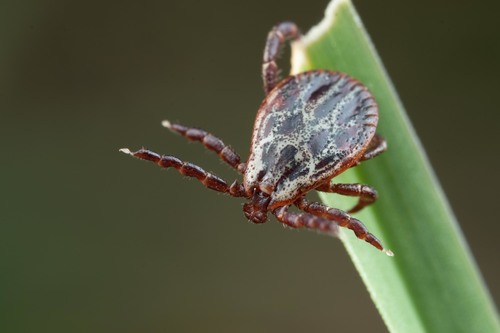
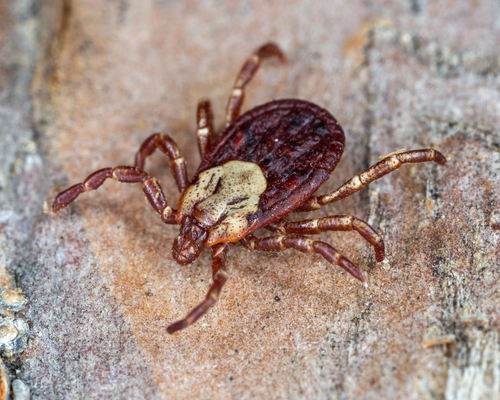
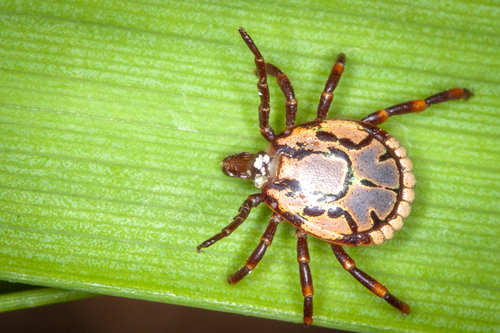
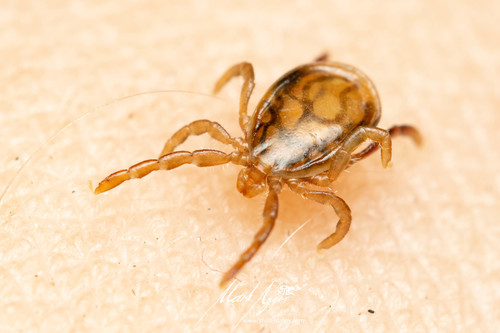
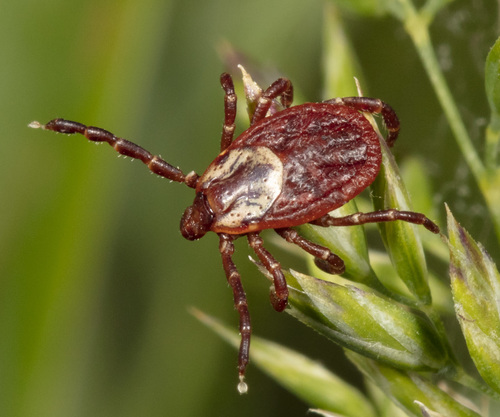
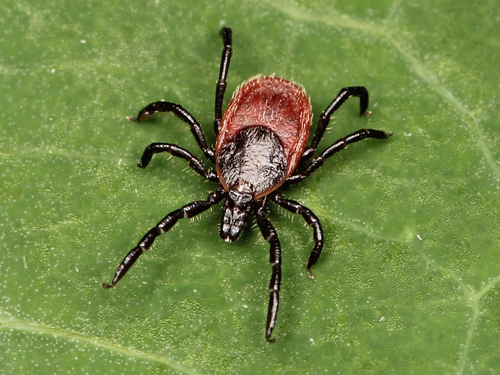
Ixodes pacificus Cooley & Kohls, 1943, commonly called the western black-legged tick, is a hard tick belonging to the family Ixodidae. It is a slow-feeding species that has a plated hard body armor. This tick is primarily found in the western United States and western Canada. It is most prevalent in California, and has also been recorded in Oregon, Washington, Utah, Nevada, Arizona, and British Columbia. Adult males of this species are roughly 2.54 mm long, oval-shaped, and brownish-black. A hard plate called a scutum completely covers the dorsal (back) side of adult males, which prevents them from feeding in large quantities, so male western black-legged ticks cannot become engorged with blood. Unfed adult females measure around 3.18 mm, and have a brown-black scutum on the front part of their back, an orange abdomen, and forward-projecting mouthparts adapted for feeding. When feeding, adult females can engorge with blood and expand to 9.5 mm or longer in size. The life cycle of Ixodes pacificus has four distinct stages: egg, larva, nymph, and adult, and it takes approximately three years for the species to complete a full life cycle. Eggs hatch into larvae after roughly 53 to 55 days. Larvae take blood meals from vertebrates including lizards and birds, feeding for 4 to 10 days. The protein from these blood meals allows larvae to develop into immature nymphs after roughly 37 to 38 days. To reach the adult stage, nymphs also feed on vertebrate blood for 7 to 11 days. After around 30 days following nymphal feeding, an adult tick emerges. Adult females take blood meals from medium and large mammals, then lay their eggs in leaf litter or soil. An adult female can lay between 790 and 1,300 eggs over a period of 33 to 40 days.