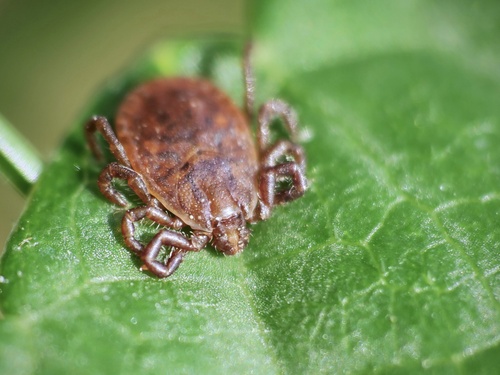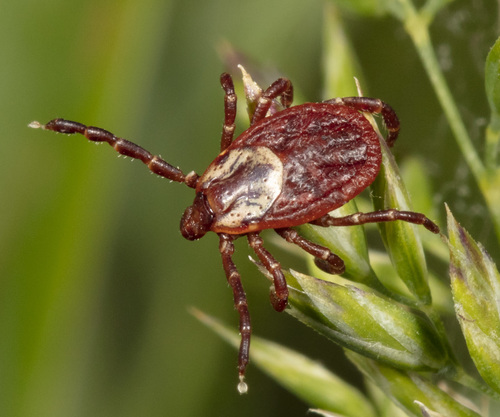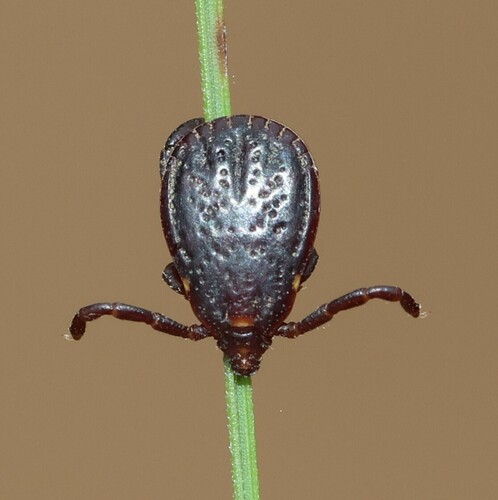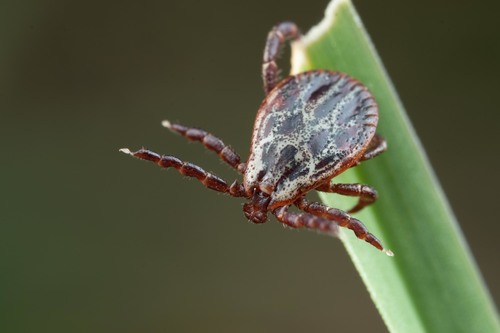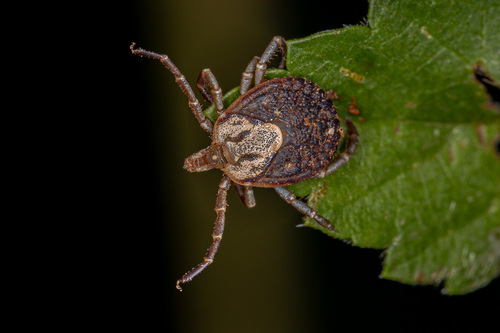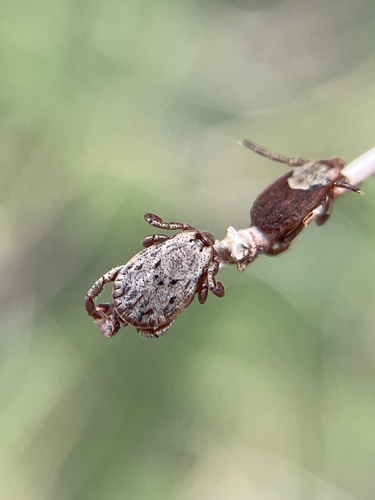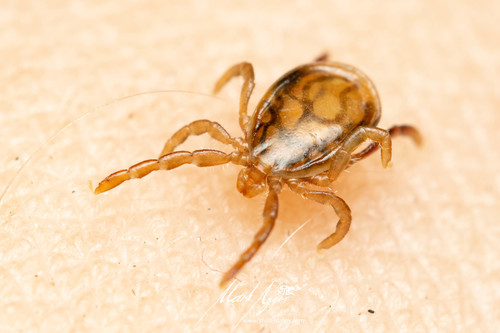
About Ixodes holocyclus Neumann, 1899
Ixodes holocyclus, commonly known as the Australian paralysis tick, is one of around 75 species that make up Australia's tick fauna, and is regarded as the most medically significant. It causes paralysis by injecting neurotoxins into its host. It typically occurs within a 20-kilometre wide strip that follows Australia's eastern coastline. Within this range, Ixodes holocyclus is the tick most often encountered by humans and their domestic pets. Since this region includes Australia's most densely populated areas, bites to people, pets and livestock are relatively common. Paralysis ticks live in many types of habitat, especially areas with high rainfall such as wet sclerophyll forest and temperate rainforest. The natural hosts of the paralysis tick include koalas, bandicoots, possums and kangaroos.
Ixodes holocyclus is mainly distributed along coastal eastern Australia, stretching from near Cooktown in far north Queensland to Lakes Entrance in Victoria. In some locations, it can be found more than 100 kilometres inland, particularly in moist escarpment and range areas such as Queensland's Bunya Mountains and the Lower Blue Mountains of New South Wales. Any distribution map only provides an approximate outline of this tick's range, as the distribution is not static. There have been reports of the tick from inland Victoria, including the north-eastern suburbs of Melbourne. This spread may reflect a general movement of insects and ticks from equatorial toward polar latitudes, a shift that may be linked to climate change.
The requirement for humid conditions largely shapes the preferred botanical habitat of this species. Low, leafy vegetation creates higher humidity by reducing the drying effects of wind and direct sunlight. This environment also suits the tick's primary host, the bandicoot, which searches for grubs and worms in leaf litter. Certain types of vegetation may support the growth of paralysis tick populations. There are conflicting reports on whether paralysis ticks climb trees: some sources note ticks climbing to the tops of trees, while others state they remain no higher than 50 centimetres above the ground.
An association between tick bites from this species and mammalian meat allergy in humans has been reported. The allergy that develops is unusual because the onset of allergic symptoms, which range from mild stomach issues to life-threatening anaphylaxis including skin rashes, swollen tongue and a severe drop in blood pressure, can happen 3 to 6 hours after eating mammalian meat (most commonly beef, lamb or pork), and often occurs many months after the tick bite. All mammals except humans and certain apes have a carbohydrate called alpha-gal (galactose-α-1,3-galactose) in their tissue fluids. When a tick feeds on the blood of a mammal such as a bandicoot, possum, cat or dog, it takes in alpha-gal into its digestive system. When the same tick attaches to a new host, such as a human, it transfers alpha-gal into the new host's tissues. Some human immune systems recognize alpha-gal as a foreign substance and produce antibodies against it; the antibody produced in this case is IgE, the type of antibody responsible for most allergic reactions. This leaves the human sensitized for a delayed allergic reaction when they later eat mammalian meats, but not chicken or fish.
Alpha-gal allergy in humans can now be identified with a blood test. The reaction to alpha-gal is different from any immediate allergic reaction to the tick itself, which is triggered by proteins in the tick's saliva rather than the carbohydrate alpha-gal. However, people who have immediate allergic reactions to the tick may have a higher chance of developing mammalian meat allergy over the following several months.