About Ixias pyrene (Linnaeus, 1764)
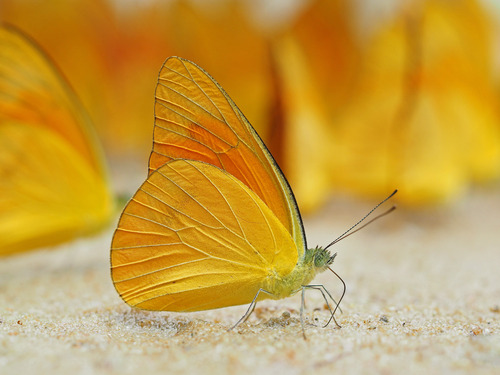
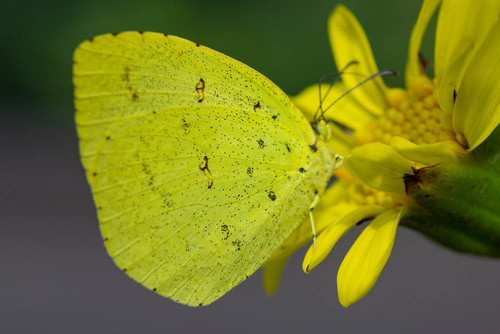
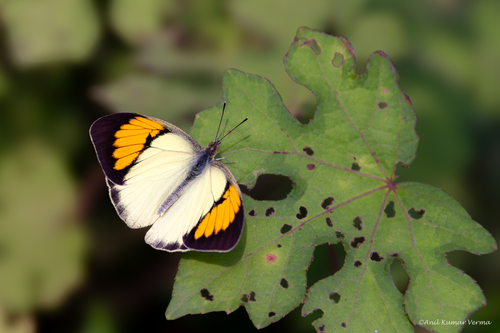
Ixias pyrene (Linnaeus, 1764) has a wingspan ranging from 50 to 55 millimeters. Dry-season brood: On the upperside of the male, the ground color is deep sulphur-yellow. For the forewing, the base and basal half of the costa are thickly sprinkled with black scales. The apical half of the wing is black, and encloses a large, irregularly triangular orange patch. The apex of this orange patch is more or less broadly rounded and blunt. The orange color extends into the apex of the wing cell, but is interrupted there by a black discocellular spot that spreads diffusely inward and joins the black oblique bar forming the base of the orange patch. All veins that cross the orange patch are black. For the hindwing, the color is uniform, with only a small amount of black scaling at the extreme base. The termen has a dusky-black, somewhat narrow border that sometimes is entirely absent, and this border decreases in width toward the posterior. On the underside, the color is a darker yellow, sparsely sprinkled with short brownish-reddish strigae and minute spots. For the forewing, the base and posterior area are broadly tinted with a whitish pale greenish hue. The strigae and minute spots are most numerous toward the apex and along the termen. Interspaces 4, 5, 6, and 8 have a curved sub-apical series of small, rounded, dull reddish-brown spots, plus a similar spot located on the discocellulars. The hindwing also has a reddish-brown spot on the discocellulars, which is followed by a postdiscal series of similar spots in interspaces 3 through 8. All or most of these spots have a white center. The spots in interspaces 5, 6, and 8 are the largest, and the spots in 5 and 6 are often coalescent. The antennae and front of the thorax are dull reddish-brown, the back of the thorax and upper side of the abdomen are fuscous black, while the underside of the head, thorax, and abdomen is yellow. On the upperside of the female, the ground color is white faintly tinged with yellow. For the forewing, the apical half is black, and encloses an irregular, broad, oblique patch of the ground color that extends into the upper apex of the cell. On the inner side of this patch, the black color is reduced to a short oblique bar that broadens at the lower apex of the cell, then continues as a somewhat slender, diffuse oblique streak to the tornus, where it abruptly broadens again and meets the black on the termen. The outer margin of the oblique white patch is irregularly crenulate, and sometimes trisinuate. The black color on the apex often forms a right angle on vein 4. On the posterior part of the white patch, there is a black spot in interspace 2 and another in interspace 3. For the hindwing, the color is uniform, with a few faint, slender fuscous transverse strigae toward the posterior. The terminal margin more often lacks a narrow dusky black edge than it has one; when present, the edge broadens anteriorly at the apices of the veins. The underside of the female is similar to that of the male, with matching markings. The ground color is a dark dull ochraceous, and the brownish-reddish strigae are more numerous than in the male. The antennae, head, thorax, and abdomen match those of the male. Wet-season brood: On the upperside of both males and females, this form differs by having a broader, more pronounced black terminal edging on the hindwing, which is often remarkably broad. For females of this brood, the ground color is pale yellow. On the underside, the brownish-reddish strigae and spots are often faint, and occasionally entirely absent in males. This species is distributed across the plains and lowlands of Sri Lanka and peninsular India. It is common in dry deciduous forests, scrub, and fallow lands, and can be found throughout the year. However, it is more common during the monsoon and post-monsoon seasons, and considerably rare in summer.