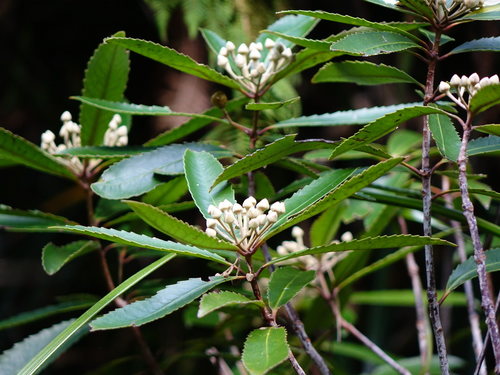
About Ixerba brexioides A.Cunn.
Ixerba brexioides, commonly known as tawari or tāwari, and called whakou when in flower, is the only species in the genus Ixerba, and is classified in the family Strasburgeriaceae. This bushy tree has thick, narrow, serrated dark green leaves, and panicles of white flowers with a green center. Its fruit is a green capsule that splits open, showing black seeds partially covered by a fleshy scarlet aril against the white interior of the fruit. This species is endemic to the northern half of the North Island of New Zealand, found roughly north of a line crossing Taupō. It is widespread from Kaitaia south to Waitomo and Te Urewera, including the Tutamoe Ranges, the Waitākere Ranges, Waipoua Forest, Te Moehau on the Coromandel Peninsula, higher elevations of the Barrier Islands, and other areas around the Bay of Plenty. It can grow at altitudes between 500 and 1200 meters, and is most often found in submontane and montane forest. It is also common in cloud forest up to 700 m. It often grows alongside New Zealand kauri (Agathis australis) in the understory of lowland rain forest. This species prefers shaded or sheltered sites, commonly in permanently damp soil near streams. While it is locally abundant, individual plants are usually widely spaced. It is also common in regenerating forests alongside tawheowheo (Quintinia serrata). Tawari uses a mass flowering strategy, and produces abundant nectar that attracts a wide range of visitors. Each flower produces an average of 18 μl of nectar with an average concentration of 20% brix. Pollination is primarily done by birds. In modified forests with fewer birds, large flies and moths are the most frequent flower visitors, followed by honey bees, bumblebees, native bees, wasps, and beetles. Features of its floral structure, such as its widely spreading anthers, suggest adaptation to bird pollination. Seed capsules develop between January and April each year, then split open to reveal up to ten glossy purple-black seeds, each partially covered by an orange fleshy aril. Seeds are primarily dispersed by birds, including recorded species kererū, pōpokotea, hihi, and kākā. Tawari is a rich source of nectar, which is often produced in such large quantities that bees can make monofloral honey, meaning the honey is made primarily from tawari flower nectar. Tawari honey is regularly sold in food shops across New Zealand. Tawari nectar contains high amounts of fructose and water, which makes the resulting honey thin, but it still crystallizes quickly. This honey is light in color and has a flavor similar to butterscotch. It contains relatively little pollen, and honey can be marketed as tawari honey if at least 20% of its pollen comes from this species. Its bark can produce a black dye that has been used to dye flax. Māori traditionally used the tree's flowers to make necklaces and other adornments worn during festivities. Tawari is known to be very difficult to grow in gardens. It requires a sheltered location, humus-rich soil, and good drainage, and the soil must never be allowed to dry out. The species likely depends on mycorrhiza to grow well, and it performs much better when planted next to kapuka (Griselinia littoralis).

