About Ithaginis cruentus (Hardwicke, 1821)
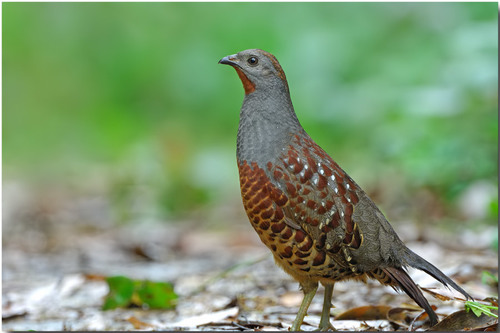
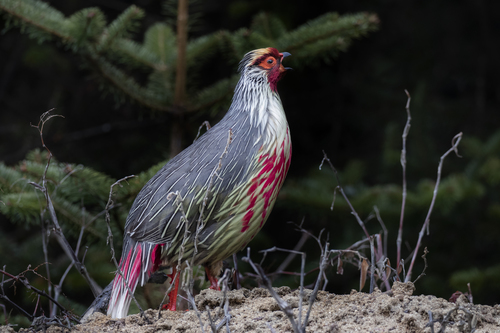
The blood pheasant (Ithaginis cruentus) is the size of a small fowl, reaching approximately 17 inches (43 cm) in total length. It has a short, convex, very strong black bill, with feathers between the bill and eye, and a small crest made up of multi-colored feathers. The upper plumage is dark ash with white shafts, while wing coverts have various green tints, with broad white streaks running along each feather. Chin feathers are a deep crimson. The feathers on the breast, belly, and sides are lance-shaped, of varying lengths, with green tips and crimson margins; together, these markings resemble splatters of blood scattered across the breast and belly. The tail is made of 12 subequal, rounded feathers with white shafts and whitish tips, while the tail coverts are a rich crimson red. Both males and females have red feet and a distinct ring of bare skin around the eye that is typically crimson, though it is orange in a small number of subspecies. Females have more uniform coloration, being dull brown overall, and often have gray coloring on the nape. While some described subspecies are highly distinctive, others are not, and some variation appears to be clinal. As a result, the number of valid subspecies is disputed, with different authorities recognizing between 11 and 15. Subspecies mainly differ in male plumage, particularly the amount of red or black on the throat, forehead, neck, chest, and tail, and whether rufous coloring is present on the wings. Blood pheasants inhabit the mountains of Nepal, Sikkim, northern Myanmar, Tibet, and central and south-central China, where they prefer coniferous or mixed forests and scrub areas located near the snowline. Their range shifts with the seasons: they live at higher elevations during the summer, and move to lower elevations in fall and winter as snow cover increases. Unlike the common pheasant, the blood pheasant is monogamous. Breeding season starts at the end of April, when males begin courtship. Males display in front of females by flying at each other breast-to-breast, biting each other's wattles, or performing high leaps that include kicks toward the other's bill. Female mate choice depends on factors such as tail length, ear tuft length, and the presence of black points in the wattle. Neither wattle size, wattle color, nor plumage brightness affect female mate choice. Blood pheasants reach sexual maturity at one year of age. In early May, mature females begin building nests under paddy straw heaps surrounded by trees, in brush, in small caves, or in tree holes close to the ground. Females excavate shallow pot-shaped nests and line them with moss, pine needles, and feathers. A female lays 4 to 14 yellowish-white eggs marked with brown speckles, laying one egg every two or three days. During the 27 to 33 day incubation period, the male defends the shared territory against other male blood pheasants. Living in inhospitable high-elevation environments has required the blood pheasant to develop adaptations to hypoxia and high levels of ultraviolet radiation. When foraging, blood pheasants move along with the shifting snow line, feeding on moss, ferns, pine shoots, and lichens.