About Itajahya galericulata Möller
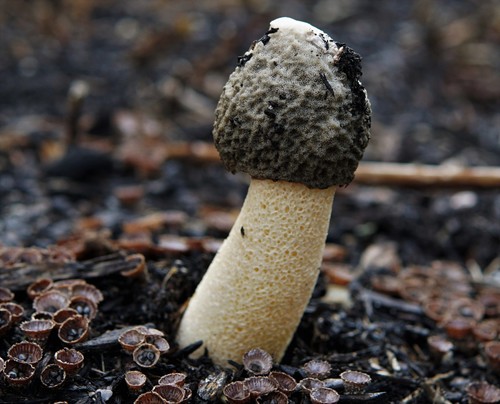
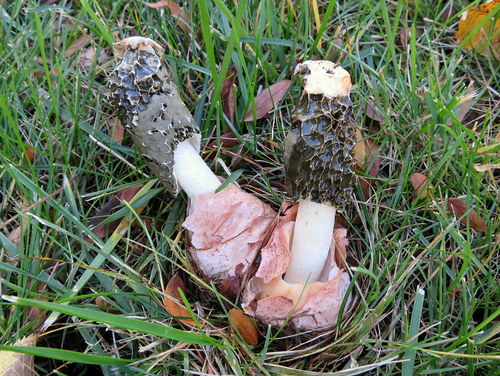
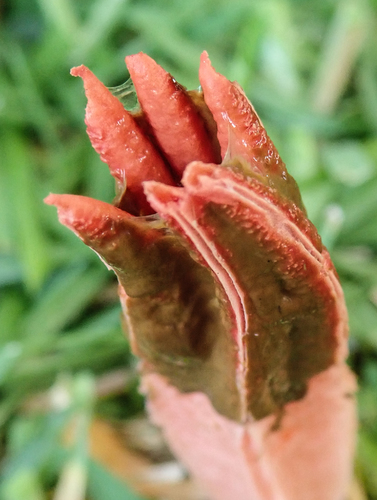
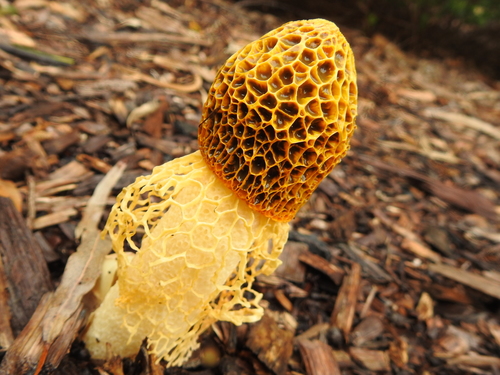
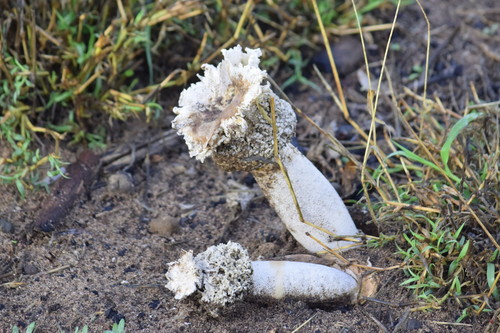
Itajahya galericulata Möller is a species in the stinkhorn family Phallaceae, and shares key traits with other members of this family. Its fruiting body (also called a sporocarp) grows from an egg-like structure, traces of which may disappear once the fungus reaches maturity. At some point in its development, the fruiting body is covered in foul-smelling slime. For this specific species, a hollow, somewhat egg-shaped or cylindrical cap (also called a pileus) sits on top of a slender, fleshy or spongy stalk called a stipe. The cap has a granular surface, made up of small, wrinkled knots of tissue surrounded by dark brown, sticky spore-containing slime called gleba. Unlike other stinkhorns, the spore-bearing gleba of this species produces a strong odor that is not foul, and may smell similar to yeasty dough. The main feature that separates the genus Itajahya from other groups in the stinkhorn family is a patch of whitish tissue called a calyptra or operculum that sits on top of the pileus. Itajahya galericulata is rarely observed and is one of the lesser-known members of the stinkhorn family. GBIF distribution records document occurrences of this species in arid and semi-arid environments across the Americas, southern and eastern Africa, India, and Australia. In Australia, this fungus lives in dry mulga country that receives less than 50 cm of annual rainfall. In North America, it is reported to grow in large groups in gardens and cultivated areas. In South Africa, it is commonly found growing in association with Jacaranda mimosifolia, a South American tree widely planted as an ornamental in gardens and along streets. It is possible that the fungus was introduced to South Africa in planting pots containing Jacaranda mimosifolia. The subterranean mycelia of Itajahya galericulata are saprobic, meaning they get their nutrition from decayed organic matter. Mature fruiting bodies can grow up to 15 cm (around 6 inches) tall. Like other stinkhorns, the odorous gleba attracts insects. The gleba sticks to the insects' legs, and the insects carry spores to new locations where the spores can germinate. Germination produces a new mycelial network that decomposes organic matter, which may then go on to produce a new stinkhorn fruiting body.