About Istiophorus platypterus (Shaw, 1792)
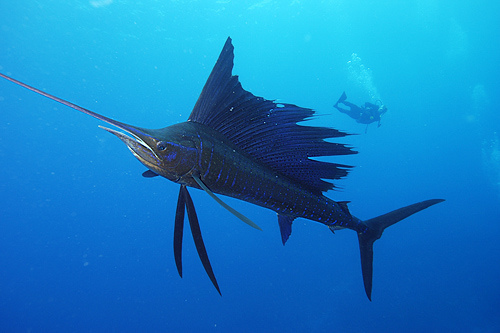
Indo-Pacific sailfish, with the scientific name Istiophorus platypterus (Shaw, 1792), is a sailfish native to the Indian and Pacific Oceans. It is naturalized in the Atlantic Ocean, and has entered the Mediterranean Sea through the Suez Canal as a Lessepsian migrant. This species is dark blue on the upper body, brown-blue on its sides, and has a silvery white underbelly. Its upper jaw is elongated into a spear shape. The first dorsal fin is greatly enlarged into the form of a sail, marked with many black spots, has a squared-off front edge, and reaches its greatest height at the midpoint of the fin. Its pelvic fins are very narrow, and extend almost to the anus. The body is covered with embedded, blunt-tipped scales. The lateral line curves above the pectoral fin, then runs straight to the base of the tail. Indo-Pacific sailfish have a large, sharp bill that they use for hunting. They feed on tuna and mackerel, some of the fastest fish found in the ocean. Most scientific authorities recognize only one single species of sailfish, which is I. platypterus. Marine biologists have theorized that the sail, the enlarged dorsal fin of the sailfish, may function as a cooling and heating system for the fish. This hypothesis is based on the large network of blood vessels present in the sail, and the sail-raising behavior that sailfish exhibit at or near the water surface before or after high-speed swimming bursts. The IUCN classifies this species as the cosmopolitan sailfish, while FishBase recognizes two separate species of sailfish.